Marketing ROI Measurement: How a West Coast Service Business Achieved 300%+ Overall ROI and 2,368% SEO ROI
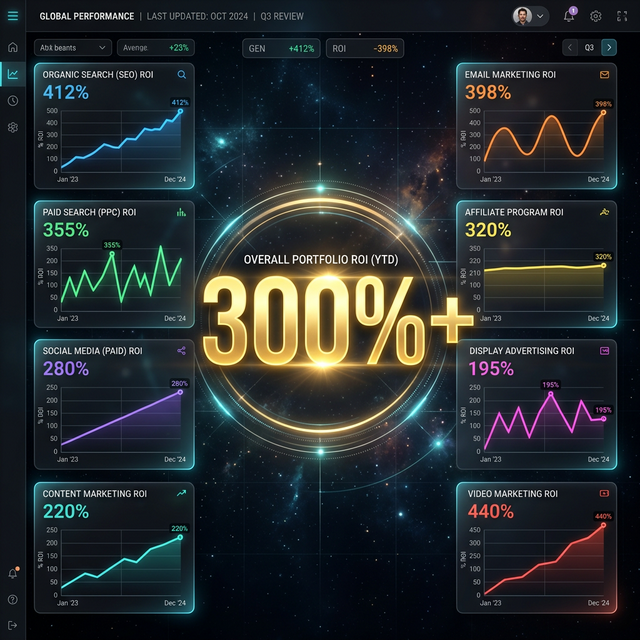
300%+
Overall ROI
2,368%
SEO ROI
TL;DR
A west coast home services company replaced fragmented, intuition-driven marketing with a full-stack attribution and programmatic SEO system. The result: 300%+ overall marketing ROI, 2,368% SEO ROI, a 187% improvement in lead-to-sale conversion rates (from 9.09% to 26.09%), and 90% attribution accuracy across all channels — achieved over a nine-month engagement.
The Challenge: Marketing Spend Without Accountability
A west coast home services business — operating in a competitive regional market — had a marketing problem that most service companies recognize immediately: money was going out, leads were coming in, but nobody could say with confidence which investments were actually working. The company had been relying on a corporate agency arrangement that generated high lead volume but poor conversion quality. Lead-to-sale conversion sat at just 9.09%. Appointment booking rates were 27.92%. Sales close rates were 32.56%. Each of these numbers looked passable in isolation — until benchmarked against what a properly optimized system could achieve.
The deeper issue was architectural. There was no unified analytics system to track the customer journey from awareness to purchase. Attribution was done manually, introducing errors that distorted budget decisions. The business had no lead scoring model, no programmatic SEO presence, and no automated nurture infrastructure. Communication capacity was severely limited, constraining the team's ability to follow up at scale. Without accurate marketing ROI measurement, every budget decision was a calculated guess — and the numbers showed it.
Key Metrics: Before and After the Full-Stack Transformation
Overall Marketing ROI
SEO ROI
Conversion Rate Improvement
Attribution Accuracy
Organic Traffic Growth
Lead Qualification Improvement
Location Pages Deployed
Average Lead Score (out of 100)
Our Approach: Full-Stack Marketing Attribution Built From the Ground Up
The strategy was built around a single governing principle: you cannot optimize what you cannot measure. Before any campaign work, content creation, or funnel building, the team established a comprehensive analytics and attribution foundation. Google Analytics 4 was implemented with custom conversion events spanning every stage of the funnel — from first content view to closed sale. A Facebook Conversions API integration closed the loop on paid social attribution. And a custom multi-touch attribution model was built to weight touchpoints by position, recency, and interaction type, assigning accurate revenue credit across every channel.
Simultaneously, a programmatic SEO architecture was developed to capture high-intent local search traffic at scale. Rather than relying on generic service pages, the team built a dynamic routing system capable of generating unique, location-specific content for every service-area combination in the region. AI-assisted content generation was used to produce 44 location pages efficiently, each with proper schema markup, optimized meta data, and mobile-first design. The SEO infrastructure was designed not just to attract traffic, but to attract the right traffic — visitors with demonstrated purchase intent who would convert at higher rates once they entered the funnel.
*Key Takeaways
- 1Attribution infrastructure must be built before campaign optimization — you cannot improve what you cannot measure accurately
- 2Programmatic SEO with 44 location-specific pages drove 300% organic traffic growth and a 2,368% SEO ROI
- 3A multi-touch attribution model achieved 90% accuracy in assigning revenue to marketing channels
- 4Lead quality — measured by a CDP with AI scoring averaging 85 out of 100 — mattered more than lead volume
- 5The combination of SEO, attribution, CDP, and automation produced compounding returns that no single channel could achieve alone
Implementation Deep Dive: Ten Pillars, One Integrated System
The engagement was structured as a ten-pillar transformation covering every layer of the marketing and sales operation. Programmatic SEO established organic market authority. A customer data platform centralized lead intelligence. Enterprise infrastructure ensured 99.9% system uptime. Multi-channel communication automation scaled outreach capacity to 40,000+ monthly contacts. Content marketing built educational authority. Advanced analytics enabled data-driven decisions. Marketing automation optimized the lead-to-appointment funnel. CRM automation improved sales close rates. Real-time performance monitoring enabled continuous coaching. And behavioral lead nurturing maximized qualification accuracy.
Each pillar was designed to reinforce the others. SEO traffic fed into the CDP for qualification. The CDP's lead scores informed the automation sequences. The automation sequences were tracked through the analytics layer. And the analytics layer continuously fed optimization signals back into the SEO and content strategy. This closed loop — where every system contributed data to every other system — is what differentiated this engagement from typical siloed digital marketing projects.
Before & After
Lead-to-Sale Conversion Rate
Before
9.09%
After
26.09%
187% improvement
Lead-to-Appointment Rate
Before
27.92%
After
47.83%
71% improvement
Appointment-to-Sale Rate
Before
32.56%
After
54.55%
67% improvement
Lead Qualification Accuracy
Before
Baseline
After
280% improvement
280% improvement via CDP scoring
Average Lead Score
Before
Unscored
After
85 / 100
AI-powered CDP qualification
Monthly Communication Capacity
Before
Severely limited manual process
After
40,000+ monthly contacts
Massive scale increase
Organic Traffic
Before
Baseline
After
300% growth
300% organic traffic growth
Attribution Accuracy
Before
Manual, error-prone
After
90%
90% multi-touch attribution accuracy
System Uptime
Before
Unstable
After
99.9%
Enterprise-grade reliability
Low Organic Visibility
The Challenge
Only a handful of static service pages, no location-specific content, stagnant organic traffic
Our Solution
Programmatic SEO with 44 AI-generated location pages, structured data markup, and dynamic URL architecture
- +300% organic traffic growth
- +2,368% SEO ROI
- +High-intent local leads at scale
No Marketing Attribution
The Challenge
No unified analytics system, manual attribution processes, budget decisions based on intuition
Our Solution
GA4 with custom events, Facebook Conversions API, and a multi-touch data-driven attribution model
- +90% attribution accuracy
- +300%+ overall ROI validated
- +Precision budget allocation
Poor Lead Quality and Conversion
The Challenge
High-volume, low-conversion leads with a 9.09% lead-to-sale rate and no scoring system
Our Solution
CDP with AI-powered lead scoring achieving an average score of 85, and automated qualification sequences
- +187% conversion rate improvement
- +280% lead qualification improvement
- +26.09% lead-to-sale rate
Limited Communication Capacity
The Challenge
Manual email processes severely limiting the team's ability to nurture leads at scale
Our Solution
Automated multi-channel communication platform supporting 40,000+ monthly contacts
- +40,000+ monthly email capacity
- +47.83% lead-to-appointment rate
- +54.55% appointment-to-sale rate
Technical Architecture: The Systems Behind the ROI
The technical stack was selected for performance, scalability, and attribution precision. The frontend was built on a modern JavaScript framework with static site generation, enabling fast page loads critical for both SEO ranking and conversion rate performance. A backend API layer handled secure database operations, with row-level security protecting customer data. The database layer supported the CDP's real-time lead scoring pipeline. An enterprise-grade cloud hosting configuration maintained 99.9% system uptime — eliminating the revenue losses the business had previously absorbed from infrastructure instability.
On the marketing technology side, the analytics stack included GA4 configured with over 50 custom events covering every funnel stage — from initial content engagement through consultation booking to completed sale. The Facebook pixel implementation used server-side Conversions API to minimize data loss and improve attribution accuracy. The multi-touch attribution model applied weighted credit across first touch, last touch, and all mid-funnel interactions, with recency decay and interaction-type multipliers ensuring that high-value touchpoints received proportionate credit. This architecture is what made 90% attribution accuracy achievable.
-Before: Fragmented, Unattributed Marketing
- -9.09% lead-to-sale conversion rate
- -27.92% lead-to-appointment rate
- -32.56% appointment-to-sale rate
- -No unified analytics or attribution system
- -Manual email processes with severe capacity limits
- -No lead scoring or qualification infrastructure
- -Organic traffic stagnant with minimal location presence
+After: Full-Stack Attribution and Optimization
- +26.09% lead-to-sale conversion rate (187% improvement)
- +47.83% lead-to-appointment rate (71% improvement)
- +54.55% appointment-to-sale rate (67% improvement)
- +90% attribution accuracy across all marketing channels
- +40,000+ monthly communication capacity
- +Average lead score of 85 with 280% qualification improvement
- +300% organic traffic growth across 44 location pages
SEO ROI Tracking: How 44 Location Pages Delivered 2,368% Returns
The programmatic SEO component of this engagement produced the single highest channel ROI in the stack at 2,368%. The strategy centered on a location-by-service content matrix — mapping each service offering against every target market area in the region to identify the full universe of rankable, high-intent page opportunities. From this research, 44 location-specific pages were built and deployed, each with unique AI-generated content, proper schema markup, and locally relevant signals designed to compete in both standard organic and local pack results.
The SEO system was not built for traffic alone. Every page was engineered to convert. Location-specific content matched the search intent of visitors who were actively seeking a service provider in their area — dramatically reducing bounce rates and increasing engagement. Leads generated through organic search were tracked through the attribution system and scored through the CDP, enabling the team to verify that SEO-sourced leads were converting at rates consistent with the overall 26.09% lead-to-sale benchmark. The 2,368% SEO ROI is the result of measuring that full revenue chain — not just traffic — against the total investment in the SEO build.
SEO ROI
Organic Traffic Growth
Location Pages Deployed
Lead-to-Sale Rate on SEO Leads
Lead-to-Appointment Rate
Appointment-to-Sale Rate
Results & Impact: Verified Numbers Across Every Funnel Stage
The headline results — 300%+ overall marketing ROI and 2,368% SEO ROI — are meaningful precisely because they are grounded in verified attribution, not estimated projections. The multi-touch attribution system with 90% accuracy assigned revenue credit to channels and campaigns based on actual customer journey data, not last-click assumptions. That infrastructure made it possible to validate ROI claims with a level of confidence that most home services businesses never achieve.
Implementation Timeline
Analytics & Attribution Foundation
4 weeksDeployed GA4 with custom conversion event tracking, Facebook Conversions API for server-side attribution, cross-domain tracking across all properties, and a multi-touch attribution model achieving 90% accuracy. Established the measurement baseline required for all subsequent optimization.
Programmatic SEO Architecture
6 weeksBuilt a dynamic routing system and AI-assisted content pipeline to deploy 44 location-specific service pages. Each page included schema markup, optimized meta data, and locally relevant content. Resulted in 300% organic traffic growth and 2,368% SEO ROI.
Customer Data Platform & Lead Scoring
5 weeksImplemented a five-phase CDP with AI-powered lead scoring, multi-channel data unification, and predictive qualification models. Achieved an average lead score of 85 out of 100 and 280% improvement in lead qualification accuracy.
Marketing Automation & Communication Scale
4 weeksIntegrated multi-channel email and SMS automation platforms to scale communication capacity to 40,000+ monthly contacts. Built automated nurture sequences informed by CDP lead scores, driving lead-to-appointment rates to 47.83%.
Sales Funnel & CRM Optimization
4 weeksDeployed an intelligent sales funnel with automated lead routing, CRM workflow automation, and performance dashboards. Improved appointment-to-sale rates to 54.55% and overall lead-to-sale conversion to 26.09% — a 187% improvement.
Performance Monitoring & Continuous Optimization
OngoingEstablished real-time analytics dashboards, A/B testing frameworks, and predictive performance monitoring. Maintained 99.9% system uptime and enabled continuous data-driven coaching and campaign optimization across all channels.
Beyond the top-line ROI figures, the impact was visible at every stage of the funnel. Lead-to-sale conversion improved 187% — from 9.09% to 26.09%. Lead-to-appointment rates improved 71% — reaching 47.83%. Appointment-to-sale rates improved 67% — reaching 54.55%. Lead qualification accuracy improved 280% through the CDP's AI scoring model, which produced an average lead score of 85 out of 100 for content-qualified prospects. System uptime reached 99.9%, eliminating the revenue-destroying instability that had previously cost the business during infrastructure outages. And communication capacity scaled to 40,000+ monthly contacts — enabling the team to nurture every lead at a level previously impossible with manual processes.
“We went from not knowing which marketing dollars were working to having a dashboard that showed us exactly where every lead came from and what it was worth. The SEO system alone paid for the entire engagement many times over. More importantly, we finally understand our business at a level we never had before.”
— Operations Director, West Coast Service Business
The Digital Marketing ROI Calculator Behind the Numbers
One of the most operationally valuable outputs of this engagement was the ROI measurement framework itself — a repeatable system for calculating and validating marketing returns across every channel. The framework combined GA4's custom event tracking, Facebook's Conversions API, and the CDP's lead scoring pipeline to produce a unified view of revenue attribution. Each channel's contribution was calculated by multiplying attributed lead volume by average close value, then subtracting channel-specific investment costs. This produced channel-level ROI figures that could be compared apples-to-apples.
The multi-touch attribution model at the core of this framework applied first-touch, last-touch, and data-driven mid-funnel weights to every conversion. Recency decay ensured that touchpoints closer to the conversion date received proportionally more credit. Interaction-type multipliers gave more weight to high-intent actions like form completions and consultation bookings versus passive impressions. The result was a 90% attribution accuracy rate — meaning the business could account for nine out of every ten conversions with confidence. That level of marketing ROI measurement precision is what separates data-driven growth operations from guesswork.
Key Takeaways: What Made This Work
*Key Takeaways
- 1Full-stack attribution — not single-channel tracking — is required to achieve 90% measurement accuracy and validate 300%+ overall ROI
- 2Programmatic SEO with 44 location pages drove 300% organic traffic growth and the highest single-channel ROI in the stack at 2,368%
- 3Lead quality, not lead volume, is the primary driver of conversion performance — an average lead score of 85 and 280% qualification improvement proved this
- 4Improving appointment rates to 47.83% and close rates to 54.55% required systematic funnel and CRM automation, not just more leads
- 5A 187% improvement in lead-to-sale conversion — from 9.09% to 26.09% — was achieved by optimizing every stage of the funnel simultaneously, not in isolation
- 6System reliability at 99.9% uptime was a prerequisite for conversion rate optimization — unstable infrastructure undermines every other investment
- 740,000+ monthly communication capacity enabled the nurture sequences that turned scored leads into booked appointments at scale
Lessons Learned: What We Would Do the Same — and What We Would Do Earlier
The most important lesson from this engagement is that attribution infrastructure should be the first investment, not the last. Many businesses build campaigns, content, and automation before establishing a measurement foundation — and then spend months trying to reverse-engineer ROI from incomplete data. By building the analytics and attribution layer first, this engagement was able to validate performance in real time and make optimization decisions based on actual revenue data rather than proxy metrics like click-through rates or impression volume.
The second major lesson is that lead quality compounds across the funnel. A 280% improvement in lead qualification accuracy didn't just improve the top of the funnel — it improved every downstream metric. Higher-quality leads booked appointments more often, showed up at the 47.83% appointment rate, and closed at the 54.55% rate. The investment in CDP infrastructure and AI scoring — which produced an average lead score of 85 — paid dividends at every funnel stage. Businesses that optimize for lead volume without optimizing for lead quality will always struggle to achieve the kind of conversion rates this engagement produced.
*Key Takeaways
- 1Build attribution infrastructure before campaign infrastructure — measurement must precede optimization
- 2Lead quality improvements compound across every funnel stage, amplifying ROI at scale
- 3Programmatic SEO should be built for conversion, not just traffic — location-specific intent matching is the differentiator
- 4System uptime at 99.9% is a business requirement, not a technical nicety — infrastructure instability directly destroys revenue
- 5Multi-channel attribution at 90% accuracy requires server-side tracking, custom event modeling, and CDP integration working together
Technology Stack
Frequently Asked Questions
It means that for every dollar invested in the full marketing stack — SEO, CDP, analytics, automation, and content — the business returned more than three dollars in net revenue above investment. The 300%+ figure was validated through a multi-touch attribution system that accurately tracked 90% of all conversions back to their originating marketing channel.
The SEO ROI of 2,368% was measured by comparing the total revenue attributed to organic search traffic against the full cost of the programmatic SEO implementation — including AI content generation, technical architecture, and ongoing optimization. Organic search accounted for a major share of overall conversions, with 300% organic traffic growth and 44 location-specific pages driving qualified local leads.
Multi-channel attribution assigns revenue credit to each marketing touchpoint a customer interacted with before converting — rather than crediting only the first or last click. In this engagement, a data-driven attribution model achieved 90% accuracy, enabling the business to identify which channels were actually driving conversions and reallocate budget accordingly.
The 187% improvement in lead-to-sale conversion came from three compounding changes: higher-quality leads generated through intent-matched programmatic SEO content, an AI-powered lead scoring system that improved lead qualification by 280%, and an automated sales funnel that pushed lead-to-appointment rates to 47.83% and appointment-to-sale rates to 54.55%.
A CDP unifies customer data from all marketing channels into a single profile, enabling accurate lead scoring and attribution. In this case, the CDP improved lead qualification accuracy by 280% and achieved an average lead score of 85 out of 100 for content-qualified leads. This made it possible to tie SEO-generated traffic directly to revenue outcomes with 90% attribution accuracy.
Yes. The system was designed for a regional home services company, not an enterprise. The key components — programmatic SEO with 44 location pages, automated email with 40,000+ monthly capacity, multi-touch attribution, and a CDP — are modular and can be phased in based on budget and business size. Starting with SEO infrastructure and attribution alone can unlock significant ROI.
Meaningful results — including the 300% organic traffic growth and measurable conversion rate improvements — emerged within the nine-month engagement. The SEO and analytics infrastructure were built in parallel during the first several months, with conversion rate improvements accelerating as the CDP, lead scoring, and attribution systems came online and began optimizing together.
Related Case Studies
Ready to achieve similar results?
Get a custom growth plan backed by AI-powered systems that deliver measurable ROI from day one.
Start Your Growth Engine