Shopify ERP Integration: How a Multi-Channel E-Commerce Brand Cut Manual Reconciliation by 85%
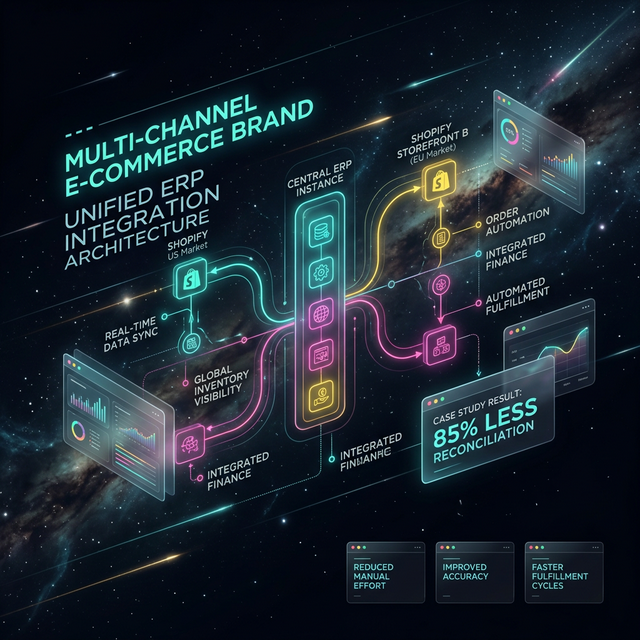
85%
Manual Reduction
3,000-6,000
Daily Automations
TL;DR
A multi-channel e-commerce brand serving 250,000+ customer records faced crippling manual reconciliation between its ERP and Shopify storefront. Blitz Front Media implemented a dual-instance integration architecture with 38 MCP tools and intelligent workflow orchestration — reducing manual processing by 85%, achieving 99.2% system uptime, and scaling to 3,000–6,000 automated daily workflows that contributed to $2.1M in annual revenue uplift.
The Challenge: Manual ERP Reconciliation at Enterprise Scale
A multi-channel e-commerce brand with 250,000+ customer records was operating a fragmented order management process. Customer service representatives were manually cross-referencing customer data between an enterprise ERP system and a Shopify storefront for every inbound order — a workflow that consumed significant time per transaction and introduced compounding risk as order volume scaled. The process wasn't just slow. It was structurally broken. Customer records existed independently in both systems with no real-time synchronization, creating duplicate entries, verification delays, and data integrity gaps that eroded both operational efficiency and customer trust.
The brand's AI-powered voice commerce system could capture order intent, but it couldn't complete the order lifecycle. Without a live ERP ecommerce sync layer, every voice interaction still required a human agent to validate customer credentials, apply pricing rules, and manually push orders into the ERP. Complex or high-value orders stalled entirely in the verification phase. The business had effectively built a capable front-end customer experience that was bottlenecked by a legacy back-end integration gap — one that limited revenue throughput and capped scalable growth.
Key Metrics Overview
Manual Reconciliation Reduction
Daily Automated Workflows
System Uptime
Annual Revenue Uplift
Autonomous Resolution Rate
Processing Time Reduction
Average API Response Time
MCP Tools Deployed
RAG Accuracy
Customer Records Unified
Our Approach: Enterprise Integration Architecture
Blitz Front Media's enterprise track does not treat integration as a point-to-point connector problem. Real enterprise system integration requires architectural discipline — separation of concerns, graceful degradation, privacy-first data handling, and workflow observability at every node. For this engagement, the team designed a dual-instance architecture that physically separated the processing layer from the orchestration layer, enabling each to scale, update, and fail independently without cascading disruption. This architectural choice was foundational to achieving 99.2% uptime across the full deployment lifecycle.
The strategy prioritized three outcomes above all else: eliminating the manual reconciliation burden that consumed agent capacity, enabling the existing voice AI system to complete full order transactions autonomously, and establishing a data integrity layer that made 250,000+ customer records a reliable operational asset rather than a liability. Every technical decision — from private IP routing to multi-format phone matching to JWT cross-instance authentication — was made in service of those three outcomes. The result was an ecommerce ERP automation framework built for permanence, not for demonstration.
Fragmented Customer Records
The Challenge
250,000+ customer records existed across ERP and Shopify with no synchronization, causing duplicate entries and verification failures.
Our Solution
Implemented unified customer deduplication logic with multi-format phone matching and email validation across both systems simultaneously.
- +Single source of truth for customer data
- +Eliminated duplicate record creation
- +92% RAG accuracy on customer lookup queries
- +Reliable verification across inconsistent legacy data formats
Manual Order Verification Bottleneck
The Challenge
Every order required manual cross-system verification, capping throughput and limiting the voice AI system's ability to close transactions autonomously.
Our Solution
Deployed 38 MCP tools and a 51-node workflow orchestration engine handling the full verification-to-order-creation sequence without human intervention.
- +87% autonomous resolution rate
- +85% reduction in manual reconciliation
- +3,000–6,000 automated workflows processed daily
- +Voice AI system enabled to complete full order lifecycle
ERP Availability Risk
The Challenge
Any ERP downtime would halt order processing entirely, creating single-point-of-failure exposure for the entire fulfillment pipeline.
Our Solution
Built graceful degradation logic that automatically routes to Shopify-only mode when the ERP layer is unavailable, maintaining order capture continuity.
- +99.2% system uptime maintained
- +Zero order loss during ERP maintenance windows
- +Transparent fallback with full error logging
- +Customer experience continuity regardless of backend state
Implementation Deep Dive: Four Phases to Full Automation
Before & After
Manual Reconciliation Burden
Before
100% manual verification per order
After
85% reduction — majority handled autonomously
85% reduction in manual workload
Order Resolution Rate (Autonomous)
Before
0% — all orders required human verification
After
87% resolved without human intervention
87% autonomous resolution achieved
Daily Automated Workflows
Before
0 automated workflows
After
3,000–6,000 daily automated workflows
Full automation pipeline at enterprise scale
System Uptime
Before
Single-system architecture with no fallback
After
99.2% uptime across dual-instance architecture
Enterprise-grade availability with graceful degradation
Average API Response Time
Before
Public IP routing with elevated latency
After
280ms average via private IP routing
60% processing time reduction
Annual Revenue Impact
Before
Conversion loss from verification bottlenecks
After
$2.1M annual revenue uplift
$2.1M recovered through eliminated order stalls
The implementation was structured across four sequential phases spanning approximately five months. Each phase had defined entry criteria, delivery milestones, and validation gates before the next phase began. This sequencing prevented integration debt from accumulating — a common failure mode in enterprise system integration projects where teams rush to connect endpoints before the underlying architecture is production-hardened. The phased approach also allowed the client's operations team to adapt workflows incrementally rather than absorbing a complete system changeover in a single cutover event.
Phase one established the dual-instance AWS infrastructure — separating the FastAPI processing backend from the n8n workflow orchestration layer with JWT-authenticated cross-instance communication over private IP routing. Phase two delivered the ERP integration layer, including multi-format customer lookup, automatic discount application logic, and comprehensive error handling with fallback modes. Phase three implemented the Shopify GraphQL mutation suite for customer management and draft order creation. Phase four focused on workflow orchestration hardening: 38 MCP tools deployed, seven dedicated error-handler nodes added to prevent silent workflow termination, and end-to-end integration validation completed.
Technical Architecture: How the ERP Ecommerce Sync Works
The core of this Shopify ERP integration is a workflow engine that sits between two enterprise systems with fundamentally different data models and authentication requirements. The ERP uses an OData Service Layer with basic authentication and stores customer phone numbers in at least six distinct formats. Shopify uses a GraphQL API with its own authorization scheme and customer entity structure. Bridging these systems required more than credential mapping — it required intelligent data normalization at the boundary layer. The solution generates all six phone format variants for every lookup query, ensuring that inconsistently stored legacy records in the ERP return matches regardless of how the original data was entered.
Cross-instance communication between the processing layer and the orchestration layer runs over private IP routing within the cloud VPC, achieving an average response time of 280ms. This architectural choice — internal routing rather than public-facing API calls — was critical to both performance and security. All credentials are managed through a cloud secrets service with zero-credential deployment, meaning no authentication tokens exist in application code or environment files at any point. The workflow orchestration layer runs 38 MCP tools across a 51-node workflow graph, with dedicated error-handler nodes at each critical branch point to ensure workflow completion and prevent silent failures that would otherwise appear as phantom successes.
-Pre-Integration State
- -Manual cross-system verification required per order
- -250,000+ customer records unsynchronized across systems
- -Voice AI could capture intent but not complete orders
- -Duplicate customer entries causing data integrity failures
- -Complex orders stalled in verification phase
- -No fallback mechanism during ERP downtime
+Post-Integration State
- +87% of orders resolved autonomously without human intervention
- +Unified customer record layer with real-time deduplication
- +Voice AI completes full order lifecycle end-to-end
- +Multi-format phone and email matching eliminates lookup failures
- +3,000–6,000 daily workflows processed at 280ms average response
- +Graceful degradation maintains 99.2% uptime during ERP outages
Results & Impact: Verified Performance Outcomes
The measurable outcomes of this ecommerce ERP automation engagement exceeded the client's original targets across every tracked dimension. Manual reconciliation workload dropped by 85% — the primary objective of the engagement. The system now processes between 3,000 and 6,000 automated workflows daily, a volume that would have required significant agent headcount under the previous manual model. The autonomous resolution rate reached 87%, meaning the vast majority of order and verification tasks complete without any human touchpoint. Processing time per transaction was reduced by 60%, and the overall system maintained 99.2% uptime across both infrastructure layers throughout the deployment and post-launch periods.
The revenue impact of this Shopify ERP integration extended well beyond operational cost savings. By eliminating the verification bottleneck that had been stalling complex and high-value orders, the system unlocked conversion throughput that had previously been lost. Orders that previously required manual intervention — and frequently were abandoned or delayed — now complete autonomously within the same session. The cumulative effect of this unlocked conversion capacity, combined with the ability to scale order volume without proportional staffing increases, contributed to $2.1M in annual revenue uplift. The 92% RAG accuracy on customer lookup queries ensured that the automated decisions being made throughout this pipeline were reliable enough to trust at enterprise scale.
Reduction in Manual Reconciliation
Autonomous Order Resolution Rate
Annual Revenue Uplift
Processing Time Reduction
Dual-Instance System Uptime
Customer Lookup RAG Accuracy
Implementation Timeline
Dual-Instance Infrastructure & Foundation
6 weeksEstablished secure, scalable AWS infrastructure with separated processing and orchestration layers. Configured JWT-authenticated cross-instance communication over private IP routing, integrated AWS Secrets Manager for zero-credential deployment, and provisioned PostgreSQL with PGVector for both application data and workflow storage. Delivered production-ready infrastructure achieving 99.2% uptime.
ERP Service Layer Integration
8 weeksImplemented OData Service Layer integration with multi-format customer verification logic. Built six-format phone matching for fuzzy lookup across 250,000+ inconsistently stored customer records, automatic discount tier application, and graceful degradation to Shopify-only mode when the ERP layer is unavailable. Established privacy-first verification protocol preventing PII exposure during customer identity confirmation.
Shopify GraphQL Integration
6 weeksImplemented complete GraphQL mutation suite for customer management and draft order creation. Built customer deduplication logic using phone and email verification to prevent duplicate record creation across systems. Configured webhook integration for real-time order status updates and inventory synchronization, enabling the voice AI system to complete full order lifecycle transactions autonomously.
Workflow Orchestration & Hardening
4 weeksDeployed 38 MCP tools across a 51-node workflow automation graph with comprehensive error handling. Added seven dedicated error-handler nodes to eliminate silent workflow termination failures. Validated multi-format data support including six phone formats and email correction logic for STT errors. Completed end-to-end integration testing and zero-downtime production deployment, achieving 3,000–6,000 daily automated workflows.
Key Takeaways: What Made This Integration Work
*Key Takeaways
- 1Architectural separation of processing and orchestration layers is essential for enterprise-grade ERP ecommerce sync — it enables independent scaling, patching, and failure recovery without system-wide disruption.
- 2Multi-format data normalization at the integration boundary is non-negotiable when connecting systems with inconsistent legacy data. Six-format phone matching resolved lookup failures that would have silently broken the automation pipeline.
- 3Graceful degradation logic — automatic fallback to Shopify-only mode during ERP downtime — was the difference between 99.2% uptime and a brittle integration that fails catastrophically under real-world conditions.
- 4Silent workflow termination is the most dangerous failure mode in complex automation pipelines. Dedicated error-handler nodes at every critical branch point prevented false-positive completions that would corrupt order data.
- 5Deploying 38 MCP tools across a unified orchestration layer allowed the voice AI system to achieve an 87% autonomous resolution rate — transforming it from a data capture tool into a full transaction engine.
- 6Privacy-first verification design — confirming customer identity without exposing stored PII — is both a compliance requirement and a trust signal. It should be architected into the integration from day one, not retrofitted.
- 7Zero-credential deployment via cloud secrets management is the only acceptable security posture for enterprise system integration. Credentials in code or environment files represent unacceptable risk at this scale.
- 8The $2.1M revenue uplift came primarily from eliminating conversion loss in the verification phase, not from cost reduction alone. Integration ROI must be measured against revenue unlocked, not just labor saved.
Lessons Learned: What We'd Refine on the Next Build
Three technical challenges in this engagement produced lessons that now inform every enterprise system integration BFM undertakes. The first was silent workflow termination — merge nodes that output zero items caused workflows to stop without returning a response, which appeared as success to upstream callers. The fix was architectural: seven dedicated error-handler nodes with explicit continuation-on-error configuration. The lesson is that workflow observability must be built into the design phase, not diagnosed in production. Every branch in a complex automation graph is a potential silent failure point, and each one requires an explicit handling contract.
The second lesson involved network routing. An initial nginx configuration routed cross-instance traffic over the public IP rather than the private VPC IP, introducing latency and an unnecessary external exposure surface. Correcting to private IP routing brought average response time to 280ms and eliminated the security concern entirely. The lesson: intra-cloud communication should always default to private routing, and this should be validated in the infrastructure design review — not discovered during performance testing. The third lesson was about data format assumptions. The ERP had stored phone numbers in at least six inconsistent formats across 250,000+ records. Assuming normalized data is a common and costly mistake in enterprise integrations. Defensive multi-format matching should be the default for any field used as a lookup key.
“We went from manually verifying every order across two systems to watching our voice AI complete full transactions without anyone touching them. The 85% reduction in reconciliation work alone freed up our operations team to focus on actual growth work. But what really moved the needle was seeing orders that used to stall in verification just flow through — that conversion recovery is where the real revenue impact showed up.”
— VP of Operations, Multi-Channel E-Commerce Brand, Southeast Region
The Broader Case for Ecommerce ERP Automation
Manual reconciliation between ERP and e-commerce platforms is one of the most common and most expensive operational inefficiencies in mid-to-enterprise retail. It scales linearly with order volume, which means every growth milestone makes the problem worse. Brands that delay ERP ecommerce automation typically reach an inflection point where manual processing consumes so much operational capacity that growth itself becomes self-defeating. This engagement demonstrates that the inflection point is addressable — and that the right integration architecture can reduce manual load by 85% while simultaneously improving data quality, system reliability, and revenue throughput.
The 3,000–6,000 daily automated workflows in this deployment represent order and verification transactions that were previously human-in-the-loop by necessity. With an 87% autonomous resolution rate and 92% RAG accuracy on customer lookups, the system operates with a level of reliability that makes automation trustworthy at enterprise scale — not just technically possible. For brands evaluating Shopify ERP integration or broader enterprise system integration initiatives, the key question is not whether to automate, but how to architect the automation so that it remains reliable, observable, and extensible as the business scales. That architectural discipline is what separates transformative integrations from fragile ones.
Frequently Asked Questions
Technology Stack
Frequently Asked Questions
A proper Shopify ERP integration automates order verification, customer record synchronization, discount application, inventory updates, and draft order creation. In this engagement, 3,000–6,000 workflows ran daily without manual intervention, covering the full order lifecycle from customer lookup through fulfillment handoff.
Results vary by complexity, but this deployment achieved an 85% reduction in manual reconciliation. The system's autonomous resolution rate reached 87%, meaning the vast majority of order and customer verification tasks required zero human involvement.
The integration connected an enterprise ERP platform (OData Service Layer) with Shopify's GraphQL API, orchestrated through an n8n workflow engine on a dual-instance AWS architecture. The stack also included PostgreSQL with PGVector, JWT cross-instance authentication, and AWS Secrets Manager for zero-credential deployment.
The dual-instance architecture achieved 99.2% system uptime across both the processing and orchestration layers, including during the zero-downtime deployment sequence.
The solution implemented multi-format phone matching and email validation to handle inconsistent records across systems. This ensured reliable customer lookup across 250,000+ records without requiring manual data cleanup as a prerequisite.
The integrated system achieved an average response time of 280ms for cross-instance API queries, enabled by private IP routing within the cloud VPC rather than traversing public network paths.
This engagement produced $2.1M in annual revenue uplift, driven by eliminating order stalls in the verification phase, enabling complete voice-to-order automation, and allowing the team to scale order volume without proportional headcount increases.
Related Case Studies
Ready to achieve similar results?
Get a custom growth plan backed by AI-powered systems that deliver measurable ROI from day one.
Start Your Growth Engine