Email Marketing Automation Drives 71% More Booked Appointments for Regional Home Improvement Company
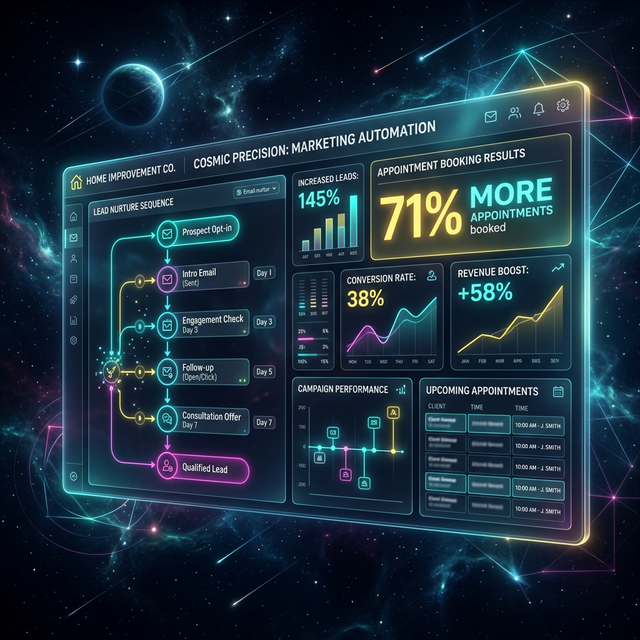
71%
Appointment Rate Lift
40,000+
Monthly Email Capacity
TL;DR
A west coast home improvement company replaced its manual, capacity-limited email setup with a multi-channel automation system featuring behavioral lead scoring, drip sequences, and appointment booking automation. The result: a 71% improvement in lead-to-appointment rates, a lead-to-sale conversion rate of 26.09%, and the capacity to send 40,000+ emails per month — up from a few hundred per day.
The Challenge: Manual Emails and a Leaky Lead Funnel
A regional home improvement company serving a competitive west coast market had a serious growth bottleneck hiding in plain sight: their email system. The business was running all customer and lead communication through a standard consumer email provider with a hard daily send limit of a few hundred messages. During seasonal peaks — when inbound consultation requests surged — that cap created a communication blackout. Leads would submit a request and wait hours or days for a response, long enough for a competitor to step in.
Beyond the volume ceiling, the team had no visibility into whether emails were being opened, clicked, or landing in spam. Follow-up was entirely manual, which meant consistency depended on who was working that day. There were no automated follow-up emails, no lead nurture email sequences, and no appointment booking automation in place. Staff were spending significant time each week composing and sending individual emails — time that should have been spent closing deals. The result was a lead-to-appointment rate that left substantial revenue on the table.
Lead-to-Sale Conversion Rate (Before)
Monthly Email Capacity Needed
Target Appointment Rate Improvement
Required System Uptime
Key Metrics at a Glance
Appointment Rate Improvement
Monthly Email Capacity (After)
Lead-to-Appointment Rate Achieved
Lead-to-Sale Conversion Rate (After)
Appointment-to-Sale Rate
Overall ROI
Average Lead Score (Out of 100)
Lead Qualification Improvement
Our Approach: A Multi-Channel Automation Strategy Built Around the Buyer Journey
The strategy centered on three core principles. First, replace the broken infrastructure with enterprise-grade email delivery capable of handling 40,000+ monthly messages without deliverability issues. Second, build behavioral lead scoring that would segment every incoming lead and route them into the right automated follow-up email sequence based on their profile and actions. Third, close the appointment gap by automating every touchpoint from the initial inquiry confirmation through pre-appointment reminders — reducing the manual labor required and ensuring no lead ever went dark.
Rather than treating email as a broadcast channel, the approach treated it as a conversion engine. Each email drip campaign automation sequence was designed to move a lead from inquiry to booked appointment with minimal sales team intervention. SMS was layered in as a parallel channel for time-sensitive notifications and appointment reminders, while a sophisticated lead scoring model — averaging 85 out of 100 for qualified leads — ensured the sales team focused energy on the leads most likely to convert.
High-Intent Leads (Hot)
The Challenge
Fast-moving prospects were being lost to slow manual follow-up and no same-day response system.
Our Solution
Instant automated confirmation email + SMS alert to sales team + accelerated drip sequence triggering within hours.
- +Same-day response for high-intent leads
- +Appointment booking automation reduces friction
- +Sales team alerted in real time
Warm Leads Still Researching
The Challenge
Prospects who weren't ready to book immediately received no nurturing, causing them to disengage or choose competitors.
Our Solution
Behavioral email drip campaign automation enrolled warm leads in a multi-week lead nurture email sequence with relevant content.
- +Sustained engagement over weeks
- +Content matched to lead behavior signals
- +47.83% lead-to-appointment rate achieved
Re-Engagement of Dormant Leads
The Challenge
A large pool of past inquiries had never converted and were sitting untouched in the contact database.
Our Solution
Re-engagement sequences deployed via automated follow-up emails with value propositions and time-sensitive offers.
- +Recovered pipeline from existing contacts
- +No additional ad spend required
- +Contributed to 300%+ overall ROI
Before & After
Lead-to-Sale Conversion Rate
Before
9.09%
After
26.09%
187% improvement
Lead-to-Appointment Rate
Before
Baseline (pre-automation)
After
47.83%
71% improvement
Appointment-to-Sale Rate
Before
Baseline (pre-automation)
After
54.55%
67% improvement
Monthly Email Sending Capacity
Before
Hundreds per day (hard cap)
After
40,000+ per month
Capacity constraint eliminated
Lead Qualification Accuracy
Before
Unscored / no model
After
85 average lead score
280% improvement in qualification accuracy
Revenue Attribution Accuracy
Before
No attribution model
After
90%
Full-funnel visibility established
Overall ROI on Automation Investment
Before
No automation investment
After
300%+
300%+ return on investment
Implementation Deep Dive: Four Phases to Full Automation
The project was executed in four sequential phases over approximately three months, each building on the foundation of the last. Phase one focused entirely on infrastructure — migrating from the legacy consumer email setup to an enterprise sending platform with dedicated IP reputation management, branded templates, and full delivery analytics. This immediately resolved the volume ceiling and the spam folder issues, unlocking the 40,000+ monthly email capacity the business needed to scale campaigns without throttling.
Phase two introduced SMS as a parallel communication channel, implemented with full TCPA compliance — including automated opt-out keyword processing and consent logging. Phase three built the transactional messaging layer: instant lead alerts to the sales team, customer-facing booking confirmations, and the multi-touch lead nurture email sequences. Phase four completed the system with a performance analytics layer, including a real-time dashboard, A/B testing framework, and 90% accurate multi-touch attribution modeling to measure which sequences and touchpoints were actually driving appointments and sales.
Technical Architecture: Lead Scoring, Segmentation, and Sequence Automation
The technical backbone of the system was an intelligent lead scoring engine that evaluated every incoming lead across five weighted dimensions: traffic source quality (15%), behavioral engagement (35%), profile completeness (25%), project timeline urgency (15%), and budget qualification signals (10%). Behavioral engagement carried the most weight because it proved to be the strongest predictor of appointment conversion. Scores were calculated in real time and updated continuously as leads interacted with emails, SMS messages, and web content. Qualified leads averaged a score of 85 out of 100 — a 280% improvement in qualification accuracy.
Lead segmentation ran in parallel with scoring, assigning each contact to a primary quality tier (hot, warm, cool, or cold) and up to four additional behavioral, lifecycle, and intent segments. These segments determined which email drip campaign automation path a lead entered, how fast the sequence ran, and which channel — email or SMS — took priority. The sequencing engine supported multiple nurture paths simultaneously and could shift a lead from one sequence to another mid-stream if their engagement signals changed — for example, accelerating a warm lead into a hot-lead track if they clicked a pricing page link.
Average Qualified Lead Score (Out of 100)
Lead Qualification Accuracy Improvement
Attribution Accuracy Across Touchpoints
Platform Uptime with Failover Architecture
Email Open Rate
Email Click-Through Rate
A/B testing was built into the automation layer from the start rather than added as an afterthought. Subject lines, call-to-action copy, send timing, and message length were all tested systematically. The winning variant logic evaluated open rate, click-through rate, and conversion rate — with a penalty applied for elevated unsubscribe rates — ensuring optimization decisions prioritized overall funnel health, not just vanity engagement metrics. The system maintained 99.9% uptime through a failover architecture that automatically rerouted messages if the primary sending platform experienced any disruption.
Results & Impact: Verified Conversion Improvements Across the Full Funnel
The results were measurable at every stage of the funnel. The lead-to-appointment rate climbed from the pre-automation baseline to 47.83% — a verified 71% improvement. That appointment volume fed a closing process that reached a 54.55% appointment-to-sale rate, representing a 67% improvement in close rates. The overall lead-to-sale conversion rate reached 26.09%, compared to a pre-automation rate of 9.09% — a 187% improvement that placed this regional company among the top performers in its market segment.
Implementation Timeline
Phase 1: Email Infrastructure Modernization
4 weeksReplaced the consumer email setup with an enterprise sending platform featuring dedicated IP reputation management, professional branded templates, delivery analytics, and a Gmail failover layer. Scaled monthly sending capacity to 40,000+ emails with 99.9% uptime.
Phase 2: SMS Marketing Platform
3 weeksIntegrated a TCPA-compliant SMS marketing channel with automated opt-out keyword processing, two-way messaging capability, appointment reminder sequences, and full SMS analytics and reporting.
Phase 3: Transactional Messaging & Drip Sequences
2 weeksBuilt the automated follow-up email and lead nurture email sequence layer: instant admin lead alerts, customer booking confirmations, multi-touch behavioral drip campaigns, and event-triggered messaging across email and SMS.
Phase 4: Lead Scoring, Segmentation & Nurture Engine
4 weeksDeployed a multi-factor behavioral lead scoring model averaging 85/100 for qualified leads (280% improvement), with dynamic segmentation routing leads into 12 automated nurture paths based on intent, behavior, and profile data.
Phase 5: Conversion Optimization & A/B Testing
3 weeksImplemented a systematic A/B testing framework across subject lines, content, CTAs, and send timing. Built automated winner selection logic and real-time performance dashboards to continuously improve sequence conversion rates.
Phase 6: Analytics, Attribution & ROI Measurement
2 weeksDeployed multi-touch attribution modeling at 90% accuracy, a comprehensive performance dashboard covering the full funnel from email open to closed sale, and automated reporting to support ongoing campaign optimization and ROI measurement.
Email engagement metrics confirmed the quality of the sequences, not just the infrastructure. The open rate reached 25% and the click-through rate reached 35% — both well above typical home improvement industry benchmarks. The attribution model, operating at 90% accuracy, allowed the team to see precisely which automated follow-up emails and lead nurture email sequence steps were generating the most appointments, enabling ongoing optimization without guesswork. The combined impact of all improvements generated 300%+ overall ROI on the automation investment.
-Before Email Marketing Automation
- -Lead-to-sale conversion rate of 9.09%
- -Manual email composition consuming staff time weekly
- -No behavioral segmentation or lead scoring
- -Inconsistent follow-up based on staff availability
- -Communication volume capped at a few hundred emails per day
- -No visibility into open rates, clicks, or deliverability
+After Email Marketing Automation
- +Lead-to-sale conversion rate of 26.09% — 187% improvement
- +40,000+ monthly emails sent automatically with zero manual composition
- +Average qualified lead score of 85/100 — 280% better qualification
- +Automated follow-up emails deployed within hours of every inquiry
- +Full email drip campaign automation with multi-channel SMS layer
- +25% open rate and 35% CTR tracked in real-time dashboard at 90% attribution accuracy
Key Takeaways for Home Improvement Businesses Considering Automation
*Key Takeaways
- 1Email marketing automation is not a luxury for home improvement companies — it is the difference between a 9.09% and a 26.09% lead-to-sale conversion rate.
- 2Appointment booking automation produces compounding returns: more appointments lead to more closings, and a 54.55% appointment-to-sale rate means the pipeline fills predictably.
- 3Lead scoring accuracy matters as much as email volume. Averaging 85 out of 100 on lead qualification means the sales team works smarter, not just harder.
- 4A/B testing built into email drip campaign automation sequences is what separates one-time wins from continuously improving performance — open rates and click-through rates can be actively managed.
- 5Multi-touch attribution at 90% accuracy is what makes a 300%+ ROI claim credible. Without it, you cannot optimize what you cannot measure.
- 6System reliability is non-negotiable: 99.9% uptime with a failover architecture ensures no lead confirmation or appointment reminder is ever lost to a platform outage.
- 7SMS layered on top of email marketing automation adds a high-response channel for time-sensitive touchpoints like appointment reminders — amplifying overall funnel performance.
Lessons Learned: What Worked and What We Would Do Differently
The single most impactful decision in the entire project was prioritizing infrastructure before sequences. Teams often want to build nurture content first, but deliverability issues and send-volume caps make sophisticated sequences irrelevant if emails never reach the inbox. By solving the infrastructure problem in phase one, every subsequent phase built on a reliable, scalable foundation. The 25% open rate and 35% click-through rate achieved after launch reflected that foundation — numbers that would have been impossible on the legacy setup.
The behavioral lead scoring model required more calibration time than initially estimated. Early in the project, the weighting between behavioral signals and profile data needed adjustment to accurately reflect which leads were truly sales-ready versus which were simply active email engagers who weren't ready to book. Once the model stabilized at an average score of 85 for qualified leads — representing a 280% improvement in qualification accuracy — the sales team's confidence in the system increased significantly. In future implementations, we would allocate additional time upfront to historical data analysis before setting initial scoring weights.
If we were running this project again, we would introduce the A/B testing framework in phase two rather than phase four. The conversion lift achieved through systematic subject line and content testing contributed meaningfully to the 71% appointment rate improvement and the 67% close rate improvement — and starting that process earlier would have compounded those gains across a longer window. The 90% attribution accuracy we ultimately achieved also should be a project kickoff requirement, not a phase four deliverable, since accurate measurement informs every optimization decision made along the way.
“Before this system, our team was manually writing follow-up emails and hoping leads didn't go cold overnight. Now every inquiry gets an immediate response, our appointment calendar fills on autopilot, and our sales team only talks to leads that the system has already qualified. The difference in our close rate has been night and day.”
— Operations Director, Regional Home Improvement Company, West Coast
Frequently Asked Questions
Technology Stack
Frequently Asked Questions
Email marketing automation refers to software-driven systems that send targeted, timed emails based on lead behavior and profile data — without manual intervention. For home improvement businesses, where every consultation booking represents significant revenue potential, automating follow-up emails ensures no lead goes cold. In this case, automation lifted the appointment rate by 71% and pushed the lead-to-sale conversion rate to 26.09%.
An email drip campaign automation system enrolls leads into pre-built sequences the moment they submit a form or take a tracked action. Each email in the sequence is triggered by time delays or behavioral signals — such as opening an email or clicking a link. For this home improvement client, multiple drip paths were created for different lead segments, resulting in a lead-to-appointment rate of 47.83% and an appointment-to-sale rate of 54.55%.
The appointment booking automation system combined instant lead confirmation emails, behavioral follow-up sequences, SMS reminders, and real-time sales team alerts. Leads received a response within hours rather than a day or more. This immediacy, combined with a structured lead nurture email sequence, drove the appointment rate lift from the pre-automation baseline to 47.83% — a 71% improvement.
The lead scoring model weighted five factors: traffic source quality, behavioral engagement, profile completeness, project timeline urgency, and budget signals. Behavioral engagement carried the heaviest weight at 35% of the total score. After implementation, qualified leads averaged a score of 85 out of 100, representing a 280% improvement in lead qualification accuracy over the pre-automation baseline.
The project delivered 300%+ overall ROI when accounting for improved conversion rates, recovered leads, and reduced manual labor. The lead-to-sale conversion rate reached 26.09% — a 187% improvement over industry standards — while the appointment-to-sale rate climbed to 54.55%, reflecting a 67% improvement in close rates attributable to better-qualified, better-nurtured leads.
The system uses multi-touch attribution modeling to assign credit across all touchpoints in the nurture sequence. Attribution accuracy reached 90%, meaning the vast majority of conversions could be traced back to specific automated follow-up emails, SMS messages, or sequence steps — giving the sales and marketing teams clear data on which touchpoints drove revenue.
Yes. The email infrastructure was architected with a primary enterprise sending platform and a backup mail service as a failover layer, delivering 99.9% system uptime. This redundancy ensures that no lead confirmation, appointment reminder, or nurture email is missed due to platform downtime — a critical requirement for businesses where every missed follow-up can mean a lost sale.
Related Case Studies
Ready to achieve similar results?
Get a custom growth plan backed by AI-powered systems that deliver measurable ROI from day one.
Start Your Growth Engine