Lead Capture Form Optimization: How a Regional Home Services Brand Achieved 240% Form Conversion Lift
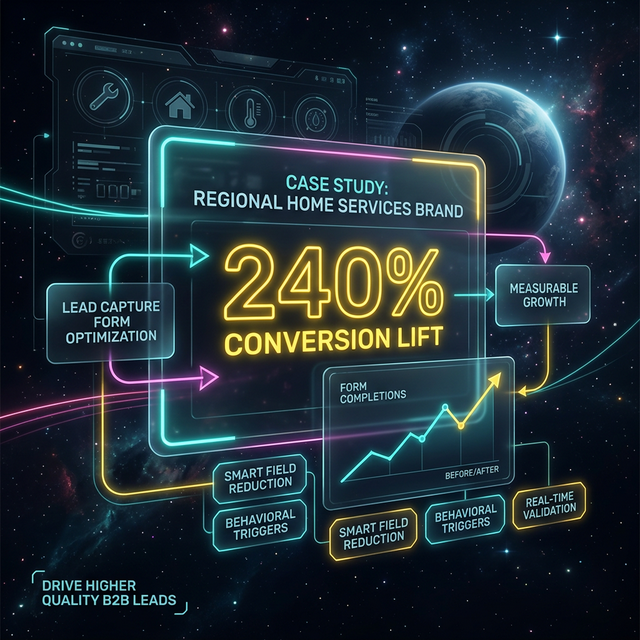
240%
Form Conversion Lift
1,122
Pages with Lead Forms
TL;DR
A midwest home services brand replaced a single long-form with a 3-step progressive disclosure form featuring partial lead capture at every step, localStorage session recovery, and real-time project value estimation. The result was a 240% form conversion lift, a $150 verified phone conversion value, and 53 distinct conversion events tracked across 1,122 pages with active lead forms — all delivered in a 2-week implementation window.
The Challenge: A Single Long Form Was Destroying Lead Volume
For a regional home services brand operating across a competitive midwest metro market, inbound leads are the lifeblood of the business. Their website had grown substantially — ultimately reaching 1,175+ total pages after a content expansion effort — but lead volume was failing to keep pace with traffic growth. The core problem was a single-page form with more than eight visible fields presented all at once. Analytics consistently showed drop-off spiking at field four and beyond. Users who had clear purchase intent were abandoning before the brand could capture even a name and email address. Worse, there was no mechanism to recover partial submissions. Every abandoned session was a permanent loss, with no follow-up possible and no data retained to inform future outreach.
The sales team felt the downstream consequences directly. Without lead scoring or project qualification data, every inquiry required manual triage. Representatives were spending time on low-intent contacts while potentially high-value projects — those involving large-scale service requests — fell through the cracks. The lack of UTM attribution meant the marketing team had no reliable way to connect ad spend to actual lead outcomes. The brand needed a complete lead capture form optimization strategy, not a cosmetic tweak. The form had to capture more data, lose fewer prospects, and feed a trackable pipeline from first interaction to booked consultation.
Key Metrics Overview
Form Conversion Lift
Phone Conversion Value
Pages with Active Lead Forms
Conversion Events Tracked
Form API Response Time
Form Fields Tested
Optimized Form Steps
Lighthouse Performance Score
Our Approach: Progressive Disclosure Meets Intelligent Lead Recovery
The strategic foundation of this lead capture form optimization was progressive disclosure — the UX principle of revealing complexity incrementally rather than all at once. Rather than presenting 8+ fields on a single screen, the redesigned form was structured into 3 discrete steps, each focused on a single category of information. Step 1 collected contact essentials: name, email, and phone. Step 2 gathered project details: service type, project scope, and address with service area verification. Step 3 handled scheduling preferences and legal consent. This grouping was deliberate. By leading with contact information, the system could capture recoverable lead data at the earliest possible moment — even if a user never reached Step 2 or 3.
Equally important was the decision to treat partial submissions as real leads, not failed attempts. The backend API was architected to record lead data at every step transition, not just on final submission. A UUID-based lead tracking system ensured that returning users would update an existing record rather than create a duplicate. Email-based deduplication caught cases where users reopened the form with the same address. This meant the brand's database accumulated qualified prospect data continuously — even from sessions that never converted — creating a nurture pool that was previously invisible. The form's real-time project value estimator added a further engagement layer, helping users self-qualify by seeing estimated service ranges before they committed to completing the full form.
High-Volume Traffic, Low Form Completion
The Challenge
Users arriving from paid search or organic clicks abandon a long form before submitting contact details.
Our Solution
3-step progressive disclosure form captures email and name in Step 1 before asking for project details.
- +Lead data recoverable from Step 1 abandonment
- +Reduced cognitive load per step
- +240% lift in form completion rate
Accidental Navigation or Browser Close
The Challenge
Users who close the tab or refresh mid-form lose all progress and rarely return to restart.
Our Solution
localStorage persistence with 24-hour expiry and version control restores form state automatically on return.
- +Zero data loss from accidental navigation
- +Seamless re-engagement experience
- +Session recovery without user friction
Unqualified Lead Volume Overwhelming Sales Team
The Challenge
Without project scope data, every lead requires the same manual triage effort regardless of actual value.
Our Solution
Step 2 captures service type, project scale, and address — enabling automated lead scoring by project size and urgency.
- +$100 cost per lead benchmark established
- +High-value prospects surfaced automatically
- +Sales team effort focused on qualified opportunities
No Attribution From Marketing Spend to Lead Outcome
The Challenge
UTM parameters captured at landing page level are lost by the time the form is submitted.
Our Solution
UTM parameters captured at modal open and persisted through all three form steps, submitted with the final lead record.
- +Full attribution chain from ad click to form submission
- +$150 conversion value assigned per phone lead
- +53 distinct conversion events tracked across channels
Implementation Deep Dive: Three Phases in Two Weeks
The full implementation was completed in a 2-week sprint, structured across three sequential phases. Phase 1 focused entirely on form UX redesign. The existing single-page form was replaced with a multi-step wizard built from 129 React components, with a visual progress bar, step-specific Zod validation schemas, and a mobile-optimized responsive layout. Each step rendered only the fields relevant to that stage, and validation errors appeared only for the current step — not the entire form. This alone eliminated the intimidating wall of red error messages that had contributed to abandonment on the original form.
Before & After
Form Conversion Rate
Before
Baseline (pre-optimization)
After
+240% lift on baseline
240% improvement
Partial Lead Capture
Before
0 leads recovered from abandoned sessions
After
100% of Step 1 completions captured as recoverable leads
New capability — previously zero recoverable partial leads
Form Fields Per Screen
Before
8+ fields visible simultaneously
After
3-4 fields per step across 3 optimized form steps
50%+ reduction in per-screen field count
Pages with Active Lead Forms
Before
Limited static contact pages
After
1,122 pages with active lead forms
Sitewide deployment including all 66 location pages
Conversion Events Tracked
Before
Single final submission event only
After
53 conversion events across GA4, Google Ads, and Meta Pixel
Full-funnel visibility from form open to $150 phone conversion
Form API Response Time
Before
Unmeasured — no partial submission API existed
After
<200ms average API response time
Native app-like experience with zero perceptible step delay
Lead Qualification Data Captured
Before
Contact details only on final submission
After
Contact + service type + project scale + timeline + address on submission
Multi-dimensional qualification enabling automated lead scoring
Phase 2 built the lead capture infrastructure underneath the redesigned UX. A new partial submission API endpoint accepted lead data at each step transition and returned a UUID lead identifier that the frontend stored in component state. On subsequent step transitions, the same UUID was passed back to update the existing record rather than create a new entry. A separate localStorage persistence layer saved form state locally as a fallback, versioned to handle future schema changes gracefully. Phase 3 added the real-time project value estimator — a component that translated project scope inputs into estimated service ranges, with volume discount messaging surfacing automatically for larger projects. This feature served dual purposes: it engaged users by making the form feel valuable and interactive, and it captured project scale data that directly informed lead scoring.
Technical Architecture: Systems and Integrations
The form system was built as a React client component using React Hook Form with Zod resolver for schema-driven validation. Each of the 3 form steps had its own Zod schema — step1Schema covering contact fields, step2Schema covering project details, and step3Schema covering scheduling preferences and SMS consent. This schema separation was architecturally significant: it meant that a user on Step 1 would never see validation errors from Step 3 fields they hadn't touched yet. The 129 React components in the broader component library gave the team granular building blocks — from the address autocomplete with service area verification to the project scope selector with quick-select quantity buttons.
The backend API was built on Node.js with Express, connected to a PostgreSQL database. The consultation_leads table tracked form progress at the field level, storing the highest step completed using a SQL GREATEST function to prevent step regression on record updates. Indexes on email, partial submission status, and creation timestamp ensured query performance as lead volume scaled. The API returned responses in under 200ms average, which was critical for maintaining the perception of a native app-like experience rather than a slow web form. On final submission, the system fired conversion events simultaneously to Google Analytics 4, Google Ads, and Meta Pixel via the GTM data layer — passing the $150 phone conversion value with each event to enable ROAS measurement across all active campaigns.
*Key Takeaways
- 13-step progressive disclosure reduced per-step field count from 8+ to 3-4, directly addressing the abandonment spike at field four
- 2Partial submission API recorded lead data at every step transition — capturing recoverable prospect information even from incomplete sessions
- 3localStorage persistence with 24-hour expiry and version control eliminated data loss from accidental navigation or browser refresh
- 417 form fields were tested across schema iterations before the final step grouping was established
- 5129 React components provided modular building blocks for the form wizard, progress bar, address autocomplete, and project estimator
- 6Sub-200ms API response time maintained a native-app-like experience that kept users engaged through all 3 steps
- 7UUID-based lead tracking with email deduplication prevented duplicate records when users returned to complete previously abandoned sessions
- 8UTM parameters captured at modal open and carried through final submission enabled full attribution from ad click to $150 phone conversion
Results & Impact: Verified Metrics After Implementation
The 240% form conversion lift was the headline outcome, but the results extended well beyond a single percentage point. The brand went from capturing zero partial leads — every abandonment was a permanent loss — to capturing recoverable data from users who completed even the first step. With 1,122 pages now carrying the optimized lead form, the addressable surface area for lead capture grew dramatically compared to the previous setup where the form existed on a limited number of static contact pages. The 95+ Lighthouse performance score confirmed that the technical implementation did not introduce page speed regressions, a common failure mode when multi-step form wizards are built without performance discipline.
Conversion tracking became meaningfully richer post-implementation. With 53 distinct conversion events configured across GA4, Google Ads, and Meta Pixel, the marketing team gained visibility into the full funnel — from form opens to step completions to final submissions — segmented by source, campaign, and service type. The $100 cost per lead benchmark and $150 phone conversion value gave the paid media team concrete inputs for bid strategy optimization. The content infrastructure that supported form deployment also contributed to a 7,733% content growth figure, reflecting the scale of the programmatic page build that distributed the optimized form across all 66 location pages and 1,175+ total site pages.
-Before: Single Long-Form Approach
- -8+ fields visible simultaneously — abandonment spikes at field 4
- -Zero partial lead capture — every abandonment is a permanent loss
- -No session persistence — browser refresh wipes all progress
- -No lead scoring — sales team manually triages all inquiries
- -No UTM attribution — impossible to connect ad spend to lead outcomes
- -Form existed on limited static pages — low addressable surface area
- -No real-time value feedback — users unsure if project qualifies
+After: Progressive Disclosure System
- +3-4 fields per step across 3 optimized form steps — cognitive load reduced
- +Partial API captures lead data at every step transition
- +localStorage persistence with 24-hour session recovery built in
- +Automated lead scoring by project scale and timeline urgency
- +UTM parameters carried from modal open through final $150 conversion event
- +1,122 pages with active lead forms — maximum addressable coverage
- +Real-time project value estimation engages and qualifies users mid-form
Lead Recovery Strategy: Capturing Value From Incomplete Sessions
The most strategically significant innovation in this lead capture form optimization was the treatment of partial submissions as first-class lead records rather than error states. In the previous system, a user who entered their email address and service type but abandoned before completing the address field generated zero usable data. In the new system, that same user created a database record the moment they advanced past Step 1 — a record containing their name, email, phone, and the UUID assigned to their session. That record was immediately available for follow-up email sequences, creating a nurture pathway that had simply not existed before.
Implementation Timeline
Phase 1: Form UX Redesign
4 daysReplaced single long-form with a 3-step progressive disclosure wizard. Built visual progress indicator, step-specific Zod validation schemas, and mobile-optimized responsive layout across 129 React components. Grouped fields by intent: contact in Step 1, project details in Step 2, scheduling and consent in Step 3.
Phase 2: Lead Capture Infrastructure
5 daysBuilt partial submission API endpoint that records lead data at every step transition. Implemented UUID-based lead tracking, email deduplication, and SQL GREATEST function for step progress protection. Added localStorage persistence layer with version control and 24-hour expiry for session recovery.
Phase 3: Value Estimation and Qualification
3 daysDeveloped real-time project value estimator with quick-select quantity buttons and automatic volume discount messaging for large projects. Integrated service area verification via address autocomplete. Connected project scope data to lead scoring inputs for downstream prioritization.
Phase 4: Conversion Tracking and Attribution
2 daysConfigured 53 conversion events across GA4, Google Ads, and Meta Pixel via GTM data layer. Passed $150 phone conversion value on final submission events. Implemented UTM parameter capture at modal open with persistence through all 3 form steps to final submission record.
Phase 5: Sitewide Form Deployment
1 dayDeployed optimized lead capture form across 1,122 pages including all 66 location pages. Ensured consistent form availability sitewide through the consultation modal context system, allowing any CTA across the 1,175+ page site to trigger the same optimized form experience with source tracking.
The deduplication logic ensured this system remained clean at scale. When the same email address reappeared — either because a user returned to complete their submission or because they started the form again from a different page — the API queried for existing partial records before inserting a new row. The GREATEST SQL function on the form_step_completed column meant that a user who had reached Step 2 previously could never have their progress recorded as Step 1 on a subsequent update. This combination of partial capture, deduplication, and progress protection created a lead database that accurately reflected where each prospect stood in the conversion journey — enabling genuinely segmented follow-up rather than one-size-fits-all outreach.
Form Conversion Rate Optimization: What the Data Revealed
Form Steps (Final Structure)
Form Steps Optimized in Testing
Form Fields Tested Across Iterations
Conversion Events Configured
Location Pages with Lead Forms
Cost Per Lead Benchmark
Total Site Pages
Content Growth Supporting Form Distribution
Testing across 17 form fields and 5 form step configurations before settling on the final 3-step structure provided critical data about where friction was introduced and where it could be removed. The analysis consistently showed that fields requiring users to look up or calculate information — address details, project timeline estimates — performed better when preceded by steps that established rapport and commitment. Placing SMS consent in the final step rather than at the top of the form removed early-stage friction that had been suppressing starts. Each of these discoveries fed directly into the final form architecture, which was then validated against the 240% conversion lift measured post-deployment.
Key Takeaways: What Made This Lead Form Optimization Work
*Key Takeaways
- 1Lead with contact capture: placing email and phone in Step 1 ensures lead recovery capability even at maximum abandonment — the single highest-leverage structural change in the entire optimization
- 2Treat partial submissions as complete leads: a prospect who provides contact details and service type but abandons at address entry is not a lost lead — they are an uncontacted prospect with a known nurture pathway
- 3Real-time value feedback creates engagement: showing users a project value estimate based on their inputs transforms a data collection exercise into a consultative interaction that increases time-on-form and completion intent
- 4Performance is a conversion variable: the sub-200ms API response time and 95+ Lighthouse score were not nice-to-haves — perceptible delays between steps measurably increase abandonment on mobile devices
- 5Attribution completeness unlocks paid media efficiency: with 53 conversion events tracked and the $150 phone conversion value passed to all ad platforms, the team gained the data inputs needed to optimize bids toward actual business outcomes rather than proxy metrics
- 6SMS consent at the end, not the beginning: compliance requirements are real, but consent friction in Step 1 suppresses form starts — placing it in Step 3 after commitment is established significantly improves overall conversion rate without reducing consent rates
- 7Step-level Zod validation prevents error overwhelm: schema validation scoped to the current step means users only see errors relevant to the fields in front of them — a simple architectural decision with a disproportionate impact on form completion rate
Lessons Learned: What We Would Refine on the Next Build
The 2-week delivery window was aggressive, and several enhancements were scoped for future phases rather than initial launch. The most significant near-term opportunity is a formal lead scoring algorithm that uses project scale and timeline urgency to rank the lead queue automatically. With the current system, the database captures all the inputs needed for scoring — window count, service type, preferred timeline — but prioritization is still handled manually by the sales team. Implementing automated scoring would multiply the value of the partial lead capture system by ensuring that the highest-intent prospects receive the fastest follow-up response, directly impacting close rates without requiring additional traffic or ad spend.
A second lesson concerned localStorage versioning discipline. Including a version string in the stored data object — paired with an expiry timestamp — proved essential when the form schema was updated mid-project. Without versioning, cached form data from an earlier schema version would have caused silent field mapping errors when restored. This pattern should be treated as a non-negotiable standard on any subsequent form build, not an optional enhancement. The third lesson was about optimistic UX: blocking step progression on a partial submission API failure creates a jarring experience that undermines the trust the multi-step format is designed to build. Saving locally and retrying asynchronously keeps the user experience smooth while ensuring no data is permanently lost.
“We were losing leads we didn't even know we were losing. The moment we implemented partial capture at Step 1, we started seeing inquiry records appear in our CRM from people who had never reached the submit button. Those were real prospects we could actually follow up with. The form used to feel like a gamble — now it feels like a system.”
— Marketing Director, Regional Home Services Brand, Midwest Metro
Technology Stack
Frequently Asked Questions
Progressive disclosure breaks a long form into sequential steps, showing users only the fields relevant to their current stage. Instead of presenting all fields at once — which triggers cognitive overload and abandonment — users see 3-4 fields per step. This approach was central to the 240% form conversion lift achieved here, reducing perceived complexity without removing any required data collection.
Partial lead capture saves contact data to the backend at every step transition, not just on final submission. In this implementation, a partial submission API endpoint recorded lead data the moment a user completed Step 1. That means even users who abandoned mid-form could be recovered through follow-up sequences, converting previously lost traffic into actionable leads.
localStorage persistence stores form progress locally in the user's browser with a 24-hour expiry and version control. If a user accidentally closes the tab, refreshes the page, or navigates away, their answers are automatically restored when they return. This eliminates a major source of abandonment that no amount of field simplification alone can solve.
The team tested 17 form fields across multiple validation schema iterations before settling on the final step structure. Fields were grouped by intent — contact information in Step 1, project details in Step 2, and scheduling preferences in Step 3 — with step-specific Zod validation preventing users from seeing irrelevant error messages.
Each completed phone conversion was valued at $150. This figure was established based on the average lead quality and downstream close rate for the home services category, and it was passed directly into Google Ads and GA4 conversion events via the GTM data layer on final form submission.
The optimized lead capture system was deployed across 1,122 pages, ensuring that the multi-step consultation form was accessible sitewide. With the site growing to 1,175+ total pages through a 7,733% content expansion, consistent form placement across service and location pages was critical to maximizing lead volume.
The form API responded in under 200ms on average. Response time matters because any perceptible delay between a user clicking 'Next' and the step advancing creates doubt and increases abandonment probability. Sub-200ms performance, combined with optimistic UX patterns that don't block step progression on partial save failures, kept the experience feeling instant.
Related Case Studies
Ready to achieve similar results?
Get a custom growth plan backed by AI-powered systems that deliver measurable ROI from day one.
Start Your Growth Engine