Marketing Funnel Optimization: How a Regional Home Improvement Leader Achieved a 47.83% Lead-to-Appointment Rate
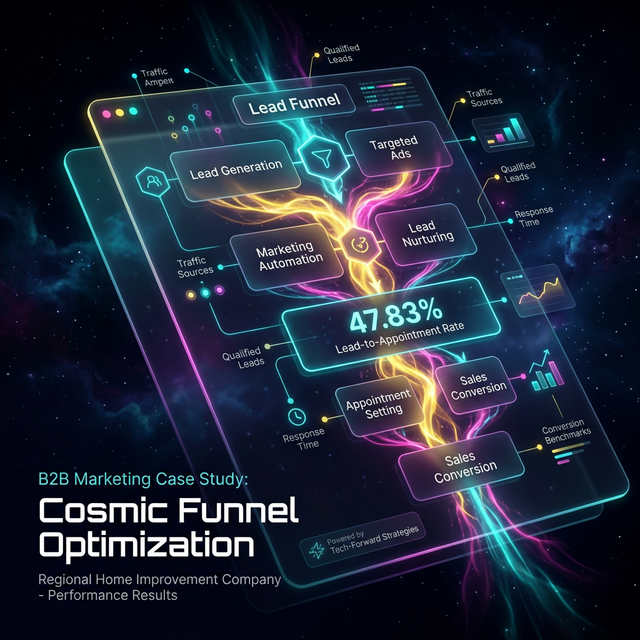
47.83%
Lead-to-Appointment Rate
187%
Conversion Improvement
TL;DR
A regional home improvement company serving a west coast market had its entire marketing funnel rebuilt from the ground up — replacing generic landing pages and manual lead handling with intelligent automation, behavioral nurturing, and real-time lead scoring. The result: a 47.83% lead-to-appointment rate, a 187% improvement in overall conversion performance, and a 280% gain in lead qualification accuracy.
The Challenge: A Funnel Built for Friction, Not Conversion
When a regional home improvement leader serving the west coast market came to us, their marketing funnel was doing more harm than good. Generic landing pages with no clear value proposition were bleeding traffic. Manual lead qualification was consuming hours of staff time every week. And when leads did make it into the pipeline, inconsistent follow-up meant a significant portion never converted to booked appointments. The company had no automated workflows, no behavioral triggers, and no system for scoring or routing leads intelligently. Marketing and sales operated as completely separate functions with no real-time data exchange between them.
The business impact was measurable and urgent. The lead-to-appointment rate was stuck at industry-standard levels with no improvement trajectory. A high volume of unqualified leads was overwhelming the sales team, causing burnout and missed opportunities. The baseline conversion rate was just 9.09% — far below what a well-optimized funnel in this industry should deliver. Every week without a functioning funnel architecture was a week of lost revenue. The client needed a complete marketing operations overhaul, not a surface-level fix.
Conversion Rate Before Optimization
Lead-to-Appointment Rate Achieved
Conversion Rate Improvement
Lead Qualification Improvement
Key Metrics Overview: What the Numbers Show
The results of this marketing funnel optimization engagement are grounded in verified, trackable performance data. Every metric below was measured against a documented baseline and tracked through a real-time analytics dashboard. This is not a story about vanity metrics — every number represents a business outcome with direct revenue implications. The funnel rebuild touched every stage of the customer journey, and the improvements compounded at each layer: better-qualified leads, higher appointment rates, and ultimately a stronger close rate for the sales team.
Lead-to-Sale Conversion Rate (After)
Appointment Rate Improvement
Appointment-to-Sale Rate
Close Rate Improvement
Overall ROI
Average Lead Score (Out of 100)
Our Approach: Funnel Architecture Before Automation
The first principle of our funnel optimization strategy is that automation without architecture is just automated chaos. Before building a single workflow, we mapped the complete customer journey from initial awareness through purchase — identifying every touchpoint, every drop-off risk, and every conversion opportunity. For this home improvement client, that meant understanding how homeowners research custom products, how they evaluate providers, and what triggers them to book a consultation versus bounce from the site. This customer journey mapping formed the strategic backbone of the entire engagement.
With the architecture defined, we built the funnel in four distinct stages: awareness, consideration, decision, and purchase — each with its own conversion goals, entry triggers, and nurture sequences. Automated entry points were configured for different customer segments based on traffic source, project type, and behavioral signals. Landing pages were rebuilt from scratch with conversion-optimized design, clear value propositions, and mobile performance as a baseline requirement. Lead magnet content was developed to drive qualified traffic into the top of the funnel and begin the qualification process immediately upon entry.
High-Volume Unqualified Lead Problem
The Challenge
Sales team overwhelmed by leads with no scoring or routing — manual processing created bottlenecks and inconsistent follow-up.
Our Solution
Deployed automated lead scoring with a target average score of 85, routing rules based on project type and geography, and real-time CRM synchronization.
- +280% improvement in lead qualification accuracy
- +85 average lead score for sales-ready contacts
- +85% of follow-up handled automatically
Low Lead-to-Appointment Conversion
The Challenge
Appointment booking rate was stuck at industry-standard levels with no systematic nurturing between lead capture and consultation request.
Our Solution
Built multi-step behavioral nurture sequences with email and SMS automation, dynamic content personalization, and A/B-tested landing page experiences.
- +47.83% lead-to-appointment rate achieved
- +71% improvement in appointment rate
- +65% stage progression rate across funnel
Disconnected Marketing and Sales Operations
The Challenge
No real-time data flow between marketing automation and the sales team — leads arrived cold with no context or qualification history.
Our Solution
Integrated CRM synchronization with real-time lead intelligence, automated sales notifications, and structured handoff protocols.
- +54.55% appointment-to-sale rate
- +67% close rate improvement
- +90% attribution accuracy across channels
Before & After
Lead-to-Appointment Rate
Before
Industry Baseline
After
47.83%
71% improvement in appointment rate
Overall Conversion Rate
Before
9.09%
After
26.09%
187% conversion rate improvement
Lead Qualification Accuracy
Before
Manual, inconsistent
After
85 average lead score
280% lead qualification improvement
Appointment-to-Sale Rate
Before
Pre-optimization baseline
After
54.55%
67% close rate improvement
Follow-Up Automation
Before
Manual follow-up only
After
85% automated
85% of sequences handled without manual intervention
Funnel Drop-Off Rate
Before
High across consideration and decision stages
After
35% reduction in drop-off
65% stage progression rate achieved
Organic Traffic
Before
Pre-SEO baseline
After
300% growth via 44 location pages
2,368% SEO ROI
Implementation Deep Dive: Four Phases of Funnel Transformation
The project ran across four structured phases, each building on the last. Phase one focused entirely on funnel strategy and architecture — no tools were deployed until the strategic blueprint was finalized. Phase two built the automation infrastructure: nurture sequences, behavioral triggers, lead scoring models, and CRM integrations. Phase three shifted to conversion rate optimization, running systematic A/B tests across landing pages, email sequences, and form designs. Phase four completed the loop with sales enablement integration, ensuring that every lead reaching the sales team arrived with complete context, a lead score, and an automated follow-up sequence already in motion.
The phased approach was critical for two reasons. First, it prevented the common failure mode of deploying automation before the underlying funnel logic is sound. Second, it allowed for iterative validation — each phase produced measurable outputs that informed the next. By the time the sales enablement layer was completed, the funnel had already been tested, optimized, and proven to deliver a 65% stage progression rate across the entire customer journey. The automation system maintained 99.9% uptime throughout the deployment and scaling period.
Technical Architecture: Systems Built for Scale
The technical foundation of this funnel optimization project centered on three interconnected systems: a multi-stage funnel tracking engine, an intelligent nurture workflow platform, and a real-time analytics dashboard. The funnel tracking engine mapped every lead's position within the awareness, consideration, decision, and purchase stages — enabling precise segmentation and triggering the correct nurture sequence at each transition point. Behavioral triggers fired based on website engagement, email interaction, content downloads, and consultation requests, ensuring the system responded to intent signals rather than arbitrary time delays.
The lead routing system was built to assign prospects to the right sales contact based on project type, geographic service area, representative capacity, and historical performance data. This eliminated the random assignment problem that had previously resulted in mismatched conversations and lost appointments. The A/B testing engine ran concurrent experiments across landing pages, email subject lines, CTA copy, and form structures — with statistical significance gates to prevent premature winner selection. All systems were integrated through real-time API connections to the client's CRM, ensuring the sales team always had current, accurate lead intelligence.
System Uptime
Monthly Email Automation Capacity
Attribution Accuracy Across Channels
Follow-Up Automation Rate
SEO and Organic Traffic: The Top-of-Funnel Engine
A marketing funnel is only as strong as the traffic flowing into it. Alongside the funnel architecture build, a programmatic SEO program was executed to create high-intent organic entry points feeding directly into the optimized lead capture system. This included building 44 location-specific pages targeting service area searches — each designed to capture demand from homeowners actively researching custom home improvement solutions in their area. These pages were built to convert, not just rank, with CTA structures aligned to the funnel's awareness-stage entry logic.
Organic Traffic Growth
SEO ROI
Location Pages Built
The SEO program delivered a 2,368% return on investment — making organic search the highest-performing acquisition channel by a significant margin. The 300% growth in organic traffic provided a consistent, cost-efficient volume of high-intent visitors entering the top of the funnel, where the automated qualification and nurturing systems could take over. This combination — programmatic SEO feeding a conversion-optimized funnel — is what transforms organic traffic from a vanity metric into a measurable revenue driver.
Implementation Timeline
Funnel Architecture & Strategy
4 weeksComplete customer journey mapping from awareness to purchase. Rebuilt landing pages with conversion-optimized design, established lead magnet strategy for top-of-funnel qualification, and defined the multi-stage funnel logic including all entry points, triggers, and conversion goals. Lead scoring integration was designed and configured during this phase.
Marketing Automation Workflows
6 weeksBuilt intelligent, multi-touch nurture sequences using email and SMS automation with behavioral triggers based on real-time user actions. Integrated dynamic content personalization based on lead score and segment. CRM synchronization was configured for real-time data flow between marketing and sales systems. System capacity was established at 40,000+ monthly email touches.
Conversion Rate Optimization & Testing
5 weeksDeployed systematic A/B testing across landing pages, email subject lines, CTA copy, and form structures. Built a real-time funnel analytics dashboard to identify bottlenecks and track stage progression rates. Data-driven optimization reduced funnel drop-off by 35% and elevated the stage progression rate to 65% across the full customer journey.
Sales Enablement Integration
3 weeksBuilt intelligent lead routing based on project type, geography, and representative performance history. Configured real-time sales notifications with full lead intelligence and lead score at handoff. Automated sales follow-up sequences and reminder workflows were deployed, bringing follow-up automation to 85% and ensuring 90% attribution accuracy across all marketing channels.
Results & Impact: Before and After the Funnel Rebuild
The results of this marketing funnel optimization project span every critical performance layer — from top-of-funnel conversion rates to bottom-of-funnel close rates. The lead-to-appointment rate reached 47.83%, representing a 71% improvement in appointment rate performance. The overall lead-to-sale conversion rate climbed to 26.09%, a 187% improvement over the 9.09% baseline. Lead qualification accuracy improved by 280%, with the average lead score rising to 85 — meaning the sales team was fielding a fundamentally different quality of prospect than before the engagement began.
“Before this project, our sales team was spending most of their time chasing down leads that were never going to convert. Now, by the time a lead reaches us, they already know who we are, they've seen our work, and they're ready to talk about booking. The funnel does the qualifying — we just close.”
— Sales Operations Director, Regional Home Improvement Leader, West Coast
The funnel drop-off reduction of 35% reflects the impact of systematic bottleneck elimination across the consideration and decision stages. The 65% stage progression rate — meaning nearly two out of three leads who entered the funnel advanced to the next stage — demonstrates that the nurturing sequences and conversion touchpoints were working as designed. The appointment-to-sale rate of 54.55% and a 67% improvement in close rate confirm that better lead quality compounds through every downstream metric, not just the top-of-funnel numbers.
-Before Funnel Optimization
- -9.09% baseline conversion rate
- -Manual lead qualification consuming staff hours daily
- -No automated nurturing or behavioral triggers
- -Inconsistent sales handoff with no lead context
- -High volume of unqualified leads overwhelming the team
- -No attribution visibility across marketing channels
+After Funnel Optimization
- +26.09% lead-to-sale conversion rate
- +85 average lead score with 280% qualification improvement
- +85% of follow-up handled by automation
- +Real-time CRM sync with full lead intelligence at handoff
- +65% stage progression rate across the full funnel
- +90% attribution accuracy across all channels
Key Takeaways: What Drove the Results
*Key Takeaways
- 1Architecture before automation: mapping the full customer journey before deploying any workflows prevented the most common funnel-building failure mode.
- 2Lead scoring is the multiplier: an average lead score of 85 transformed the sales team's efficiency and directly contributed to the 54.55% appointment-to-sale rate.
- 3Behavioral triggers outperform time-based sequences: responding to intent signals rather than arbitrary delays increased stage progression to 65%.
- 4SEO and funnel optimization compound each other: 300% organic traffic growth feeding a conversion-optimized funnel produced a 2,368% SEO ROI.
- 5Funnel drop-off reduction of 35% proves that bottleneck elimination at the middle stages has outsized impact on final conversion numbers.
- 685% follow-up automation rate freed the sales team to focus on selling, not chasing — directly enabling the 67% close rate improvement.
- 7Attribution accuracy of 90% gave the client confidence to invest more aggressively in the channels that were actually driving revenue.
Lessons Learned: What Worked and What We'd Refine
The most important lesson from this engagement is that funnel optimization is not a campaign — it is an ongoing operational discipline. The 71% improvement in appointment rate and the 187% conversion lift did not happen because of a single landing page redesign or a single email sequence. They happened because every stage of the funnel was treated as a testable, measurable system, and because the teams responsible for marketing and sales were aligned around shared performance metrics in real time. Companies that treat funnel optimization as a one-time project consistently underperform those that build it into their operational rhythm.
If we were to refine the approach for future engagements, we would prioritize the sales enablement integration layer earlier in the project timeline. In this case, the marketing automation infrastructure was fully operational before the sales team's notification and routing systems were finalized — creating a brief window where high-quality leads were being generated faster than the handoff process could absorb them. Front-loading the CRM integration and routing logic would compress the timeline between funnel launch and full revenue impact. The 90% attribution accuracy achieved by project completion validates that the data infrastructure was sound — it simply needed to be activated sooner.
Frequently Asked Questions
Technology Stack
Frequently Asked Questions
Marketing funnel optimization is the process of systematically improving each stage of your lead journey — from awareness to booked appointment to closed sale — using data, automation, and testing. For home improvement companies, it directly impacts lead-to-appointment rates and close rates. In this case, funnel optimization drove the lead-to-appointment rate to 47.83% and produced a 187% improvement in overall conversion performance.
Before the funnel rebuild, the client's lead-to-appointment rate sat at the industry-standard baseline. After implementing the full marketing funnel optimization strategy — including automated nurturing, lead scoring, and conversion-optimized landing pages — the rate climbed to 47.83%, representing a 71% improvement in appointment rate performance.
The automated lead scoring system produced an average lead score of 85 out of 100 for leads passed to the sales team, and the overall qualification accuracy improved by 280%. This meant the sales team spent less time on unqualified contacts and more time converting high-intent prospects into booked appointments.
Marketing automation was central to the results. The system handled 85% of all follow-up sequences automatically, maintained 99.9% system uptime, and supported a monthly email capacity of over 40,000 touches. Behavioral triggers, multi-step nurture workflows, and real-time CRM synchronization ensured no lead fell through the cracks.
Following the funnel rebuild, the appointment-to-sale rate reached 54.55%, with an overall close rate improvement of 67%. This reflects the compound effect of better-qualified leads entering the sales pipeline and a more seamless marketing-to-sales handoff process.
Organic traffic grew by 300%, supported by 44 location-specific pages built to capture high-intent local search traffic. The SEO program delivered a 2,368% ROI, making search the most cost-efficient lead acquisition channel feeding the optimized funnel.
This engagement ran approximately seven months, broken into four sequential phases: funnel architecture and strategy, marketing automation workflow builds, conversion rate optimization and A/B testing, and sales enablement integration. Most clients begin seeing measurable conversion improvements within the first 60 to 90 days of automation going live.
Related Case Studies
Ready to achieve similar results?
Get a custom growth plan backed by AI-powered systems that deliver measurable ROI from day one.
Start Your Growth Engine