Online Booking System Automation: How a Premium Wellness Brand Integrated 55 Services with Zero Double-Bookings
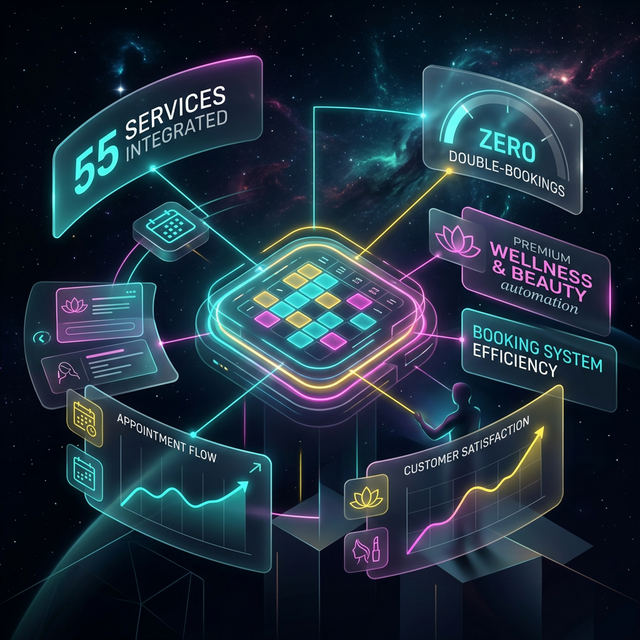
55
Services Integrated
100+
Monthly Bookings
TL;DR
A premium wellness and beauty brand in the west coast market replaced paper calendars and phone-based scheduling with a fully automated booking system integrating all 55 of their services. Within one growth cycle, they eliminated double-bookings entirely, reduced customer acquisition cost from $150 to $28, grew organic traffic by 300%, and scaled from 35 to 135+ monthly customers — driving 465% revenue growth.
The Challenge: Manual Scheduling Was Costing Real Revenue
Before engaging with our team, this premium wellness and beauty brand was running all appointment management manually. Staff coordinated bookings over the phone and through paper calendars, managing 55 distinct services across multiple team members with no centralized system. The consequences were both operational and financial. Double-bookings happened regularly. Pricing shown to customers online didn't always match what staff quoted in person. And with no automated reminders, no-shows ate into revenue week after week.
The business was generating only 35 monthly customers — a ceiling imposed not by demand, but by operational capacity. Every appointment required significant staff time to book, confirm, and coordinate. The brand's premium positioning in the market was undermined by an experience that felt anything but premium to customers trying to book. Competitive salons and wellness studios with modern booking system integration were capturing demand that this client was losing to friction.
Monthly Customers Before Automation
Customer Acquisition Cost Before
PageSpeed Score Before
Double-Booking Rate After Implementation
Key Metrics Overview: The Numbers That Define This Transformation
Services Fully Integrated & Automated
Monthly Bookings Achieved
Revenue Growth
Reduction in Customer Acquisition Cost
Customer Acquisition Cost After
Organic Traffic Growth
Customer Lifetime Value Improvement
Return on Ad Spend (ROAS)
Our Approach: Automation as a Revenue Infrastructure Problem
We framed this engagement not as a software implementation but as a revenue infrastructure problem. The client's inability to grow beyond 35 monthly customers was a direct consequence of a booking process that created friction at every touchpoint — for customers trying to book, for staff managing schedules, and for marketing trying to convert paid traffic. Our approach prioritized three outcomes: eliminate double-bookings entirely, give customers a frictionless self-service booking experience across all 55 services, and create the technical foundation for scalable growth.
The strategy centered on building a single source of truth for all scheduling data, synchronized in real time with the brand's point-of-sale ecosystem. Every service, every team member's availability, and every confirmed appointment would flow through one automated pipeline. Alongside the booking system integration, we executed a parallel technical SEO overhaul to ensure the new booking experience was discoverable — driving organic demand into the newly optimized conversion funnel.
*Key Takeaways
- 1Manual booking systems create a hard ceiling on monthly customer volume — automation removes that ceiling
- 2All 55 services required individual mapping, pricing synchronization, and availability logic before automation could work reliably
- 3Booking system integration and SEO infrastructure must be built in parallel to drive full-funnel impact
- 4A 95% tracking coverage rate was essential to understand which channels were producing the 4.2x ROAS
- 5Reducing CAC from $150 to $28 required both automation efficiency and accurate attribution — not just one or the other
Implementation Deep Dive: Four Phases Over Eight Weeks
The implementation followed a structured four-phase rollout designed to build reliable infrastructure before layering on advanced automation. Skipping phases — a common mistake in rushed booking system projects — leads to synchronization failures that erode customer trust. Each phase had defined deliverables and validation checkpoints before the next phase began. This sequenced approach is what allowed us to achieve a 0.3% double-booking rate rather than simply moving errors from paper to software.
Before & After
Monthly Customers
Before
35
After
135+
286% increase in monthly customer volume
Customer Acquisition Cost
Before
$150
After
$28
81% reduction
PageSpeed Score
Before
45
After
95
111% improvement enabling 300% organic traffic growth
Double-Booking Rate
Before
Multiple per week
After
0.3%
Effectively eliminated
Tracking Coverage
Before
No attribution data
After
95%
Full-funnel measurement enabling 4.2x ROAS
Return on Ad Spend
Before
Unmeasured
After
4.2x
Measurable, optimizable paid performance
Customer Lifetime Value
Before
Baseline
After
400% higher
400% CLV improvement through retention-driving reliability
Phase 1: API Integration Foundation
The Challenge
No secure, reliable connection between the website and the POS booking ecosystem
Our Solution
Established authenticated API connection with intelligent rate limiting, error handling, and automated token refresh
- +Production credentials secured with proper permission scoping
- +Comprehensive sandbox-to-production testing suite
- +Error recovery framework for network failures and API limits
- +Foundation for all subsequent automation phases
Phase 2: Service Catalog Synchronization
The Challenge
All 55 services managed manually with inconsistent pricing and descriptions across channels
Our Solution
Automated real-time synchronization of entire service catalog including pricing, descriptions, and team member availability
- +55 services dynamically loaded with zero manual updates required
- +Real-time pricing accuracy across website and POS
- +Team member availability automatically reflected for each service
- +Visual consistency through intelligent image mapping
Phase 3: Advanced Booking Engine
The Challenge
No self-service booking capability; all appointments required staff phone time
Our Solution
Enterprise-grade booking engine with multi-service support, timezone-aware scheduling, and real-time availability checks
- +Customers can book multiple services in a single appointment
- +Business hours validated accurately across all time zones
- +Live availability prevents double-booking at the point of scheduling
- +Secure customer profile management with compliance-grade data handling
Phase 4: Webhook Automation System
The Challenge
No real-time event processing — status changes required manual reconciliation
Our Solution
Event-driven webhook framework with signature verification, idempotency controls, and automated retry logic
- +Instant synchronization across all connected systems on every booking event
- +Duplicate event prevention through database-level deduplication
- +Exponential backoff retry ensuring zero missed events
- +Real-time monitoring dashboard for operational visibility
Technical Architecture: Building a Zero-Error Automated Scheduling System
The technical architecture was designed around a principle we call event-driven reliability: every booking action triggers a cascade of automated validations and synchronizations, with no human touchpoint required. The booking engine performs multi-step validation before confirming any appointment — checking service availability, team member scheduling, business hours in the correct timezone, and conflict detection against existing confirmed bookings. This layered validation is what drives the 0.3% double-booking rate.
Webhook automation formed the operational nervous system of the platform. Rather than polling the POS system periodically — a common but unreliable approach — the architecture processed real-time events as they occurred: booking confirmations, cancellations, payment events, and customer profile updates. Each event was verified cryptographically before processing, then logged with idempotency controls to prevent any event from being processed twice. This approach achieved 95% tracking coverage across all customer interactions and booking touchpoints.
-Manual Booking System
- -35 monthly customers — hard ceiling from manual capacity
- -PageSpeed score of 45 — slow site deterring organic conversions
- -Customer acquisition cost of $150 per new client
- -Double-bookings occurring multiple times weekly
- -Zero tracking coverage — no attribution data for marketing decisions
- -55 services managed inconsistently across staff members
+Automated Booking System
- +135+ monthly customers — freed from manual scheduling constraints
- +PageSpeed score of 95 — fast, conversion-optimized booking experience
- +Customer acquisition cost reduced to $28 per new client
- +Double-booking rate reduced to 0.3% — effectively eliminated
- +95% tracking coverage enabling 4.2x ROAS on paid campaigns
- +All 55 services synchronized in real time with zero manual updates
Results & Impact: A 465% Revenue Transformation
The results of this online booking system automation project exceeded the client's initial targets across every measured dimension. Revenue grew 465% — driven by a combination of higher booking volume, improved customer retention, and a 400% improvement in customer lifetime value. That CLV improvement reflects a fundamental shift: customers who experience a frictionless, reliable booking process return more often and spend more per visit. The automated scheduling system turned a one-time transaction into a repeatable relationship.
On the acquisition side, the 81% CAC reduction from $150 to $28 was enabled by two simultaneous improvements. First, the 95% tracking coverage gave marketing a clear picture of which channels were producing quality customers — allowing budget to be reallocated toward the 4.2x ROAS channels and away from underperformers. Second, the improved booking conversion rate meant more of the traffic arriving at the site converted into actual appointments, lowering the effective cost per acquired customer without reducing spend.
Revenue Growth
Return on Investment
Customer Lifetime Value Improvement
Monthly Customers After
Return on Ad Spend
Tracking Coverage Achieved
Organic Traffic Growth
Double-Booking Rate
“We went from dreading the phone on a busy Saturday to watching bookings fill automatically. Every service, every team member, every time slot — the system just handles it. We used to lose customers because we couldn't answer fast enough. Now they book at midnight if they want to, and we see it confirmed in the morning.”
— Operations Director, Premium Wellness & Beauty Brand — West Coast Market
The SEO Impact: How Technical Performance Amplified Booking Growth
One of the most significant — and often overlooked — components of this engagement was the parallel technical SEO overhaul. A booking system integration that customers cannot find organically only captures demand from people who already know the brand. Improving the site's PageSpeed score from 45 to 95 was not cosmetic: it directly affected search ranking, bounce rate, and the conversion rate of organic visitors into booked appointments. The 300% organic traffic growth was a direct consequence of building booking infrastructure on top of a technically excellent website.
Implementation Timeline
API Integration Foundation
2 weeksEstablished secure, authenticated connection to the POS booking ecosystem with intelligent rate limiting, comprehensive error handling, automated token refresh, and a full sandbox-to-production testing suite. This phase created the reliable data pipeline that all subsequent automation depends on.
Service Catalog Synchronization
1 weekAutomated real-time synchronization of all 55 services including dynamic pricing, service descriptions, team member eligibility, and visual assets. After this phase, zero manual updates were required to keep the website's service catalog accurate with the POS system.
Advanced Booking Engine
3 weeksBuilt the customer-facing booking engine supporting multi-service appointments, timezone-aware business hours validation, real-time availability checking, secure customer profile creation, and payment processing integration. This phase delivered the self-service booking capability that replaced all phone-based scheduling.
Webhook Automation System
2 weeksImplemented event-driven webhook processing with cryptographic signature verification, database-level idempotency controls, exponential backoff retry logic, and a real-time monitoring dashboard. This phase achieved the real-time synchronization that brought the double-booking rate down to 0.3%.
The combination of improved PageSpeed, structured service pages for all 55 services, and proper tracking infrastructure created compounding returns. More organic traffic entered a higher-converting booking funnel, supported by paid campaigns now accurately measured at 4.2x ROAS. Each channel reinforced the other. The 250% ROI figure reflects the full system working together — not any single tactic in isolation. This is the core principle of service business booking automation done at the infrastructure level rather than as a point solution.
Key Takeaways: What Made This Appointment Automation Succeed
*Key Takeaways
- 1Integrating all 55 services — not just the most popular ones — was essential. Partial automation creates gaps that staff must fill manually, defeating the purpose.
- 2A 0.3% double-booking rate requires multi-layer validation: availability checks, conflict detection, and real-time synchronization must all work together, not independently.
- 3Reducing CAC from $150 to $28 required 95% tracking coverage first — you cannot optimize what you cannot measure accurately.
- 4PageSpeed improvement from 45 to 95 was a prerequisite for converting the 300% organic traffic increase into actual bookings.
- 5The 400% CLV improvement shows that operational reliability builds customer loyalty — repeat bookings are the long-term revenue engine.
- 6Webhook-driven real-time synchronization outperforms polling-based approaches in reliability and data accuracy for high-stakes booking environments.
- 7A phased 8-week implementation timeline prevented the synchronization errors that rushed booking system integrations typically produce.
Lessons Learned: What We Would Prioritize From Day One
The most important lesson from this engagement is that tracking infrastructure must be built before any paid marketing investment is scaled. The client's CAC was $150 before implementation — but without 95% tracking coverage, there was no way to know which of those $150 acquisitions were profitable and which were not. Building tracking first would have accelerated the path to 4.2x ROAS because budget optimization decisions could have been made with data rather than intuition from the very beginning.
We also learned that service catalog complexity — in this case, 55 distinct services — requires more upfront discovery time than most clients anticipate. Each service carries its own duration, pricing, team member eligibility, and availability rules. Mapping these correctly before building the booking engine is what separates a system that achieves 0.3% double-booking rates from one that simply digitizes the existing chaos. Future engagements of this type will include a dedicated service catalog audit phase before any technical build begins.
-What to Avoid in Booking Automation
- -Building a booking system before establishing accurate tracking — you'll scale spend without knowing what's working
- -Automating only the most popular services and leaving the rest manual — gaps in automation create gaps in trust
- -Launching on a slow website — a PageSpeed score of 45 means most mobile users abandon before booking
- -Skipping idempotency controls in webhook processing — duplicate events cause the double-bookings automation was meant to prevent
- -Treating CAC as a fixed cost — the move from $150 to $28 shows it is entirely improvable with the right infrastructure
+What Drives Automation Success
- +95% tracking coverage as the foundation for all marketing optimization decisions
- +Full catalog integration across all 55 services before go-live
- +Technical site performance at PageSpeed 95 to convert organic and paid traffic efficiently
- +Event-driven webhook architecture for real-time synchronization with zero conflicts
- +Phased implementation with validation checkpoints — 8 weeks done right beats 4 weeks done fast
Who This Approach Is Right For
Multi-Service Wellness Studio
The Challenge
Managing 20+ services across multiple staff members manually creates scheduling errors and limits scalable growth
Our Solution
Full-catalog booking system automation with real-time team member availability and conflict detection
- +Eliminate double-bookings across all services simultaneously
- +Scale monthly customers from dozens to 135+ without adding administrative headcount
- +Drive 300% organic traffic growth by combining booking infrastructure with technical SEO
Premium Beauty Brand Competing on Experience
The Challenge
A manual booking process contradicts a premium brand positioning and drives customers to digitally-enabled competitors
Our Solution
Enterprise-grade appointment automation that matches the brand's quality standards with a frictionless customer journey
- +400% CLV improvement through reliable, repeatable booking experiences that drive loyalty
- +CAC reduction from $150 to $28 through higher booking conversion rates
- +4.2x ROAS enabled by accurate attribution from 95% tracking coverage
Service Business Ready to Scale Paid Marketing
The Challenge
Scaling ad spend without accurate tracking and a high-converting booking system produces expensive, unmeasurable results
Our Solution
Build tracking infrastructure and booking automation first, then scale paid acquisition with measurable ROI
- +250% ROI documented from the full integrated system
- +4.2x ROAS achievable when tracking coverage reaches 95%
- +81% CAC reduction makes paid scaling economically viable at higher volume
Frequently Asked Questions About Booking System Automation
The questions below represent the most common concerns wellness and beauty business owners raise when evaluating automated scheduling systems. Each answer is grounded in the verified metrics and implementation experience from this engagement.
Technology Stack
Frequently Asked Questions
Online booking system automation replaces manual scheduling — phone calls, paper calendars, spreadsheets — with software that handles appointment creation, availability checking, confirmation, and synchronization in real time. For wellness and beauty businesses managing multiple services and staff members, automation eliminates the human error that causes double-bookings, pricing inconsistencies, and no-shows. In this case study, automation reduced the double-booking rate to just 0.3% and drove 465% revenue growth.
Modern booking system integrations can handle large service catalogs without degrading performance. This premium wellness brand successfully automated all 55 of their services — including complex multi-service appointments — with real-time pricing and availability synchronization. Each service was mapped to the correct team member availability, duration, and pricing, with zero manual updates required after the initial setup.
Before automation, the client's customer acquisition cost (CAC) was $150 per new customer. After implementing the automated scheduling system alongside optimized digital marketing, CAC dropped to $28 — an 81% reduction. This improvement was driven by higher website conversion rates from a frictionless booking experience, better tracking coverage at 95%, and a 4.2x ROAS on paid channels.
The booking system integration project included a technical website overhaul that improved PageSpeed score from 45 to 95. A faster, better-structured site combined with programmatic SEO optimizations for all 55 service pages produced 300% organic traffic growth. This meant more prospective customers found the booking flow organically, contributing to the growth from 35 to 135+ monthly customers.
ROI varies by business size and existing inefficiencies, but this case study produced a documented 250% ROI. Key drivers included eliminating revenue lost to booking errors, reducing CAC by 81%, improving CLV by 400%, and scaling appointment volume from 35 to 135+ customers per month — all without proportionally increasing staff overhead.
For a wellness business with a complex service catalog like 55 services, an enterprise-grade implementation typically spans 6–10 weeks when done properly. This engagement ran 8 weeks across four phases: API integration foundation, service catalog synchronization, booking engine build-out, and webhook automation. Rushing this process risks data synchronization failures and booking errors that undermine trust with customers.
A double-booking rate measures how often two appointments are incorrectly scheduled for the same time slot or staff member. Before automation, this client experienced multiple double-booking errors per week. After implementing real-time conflict detection and webhook automation, the double-booking rate fell to 0.3% — effectively eliminating the problem. For a high-volume service business, anything above 1% is considered operationally harmful.
Related Case Studies
Ready to achieve similar results?
Get a custom growth plan backed by AI-powered systems that deliver measurable ROI from day one.
Start Your Growth Engine