Predictive Marketing Analytics: How a Premium Wellness Brand Achieved 84% Forecast Accuracy
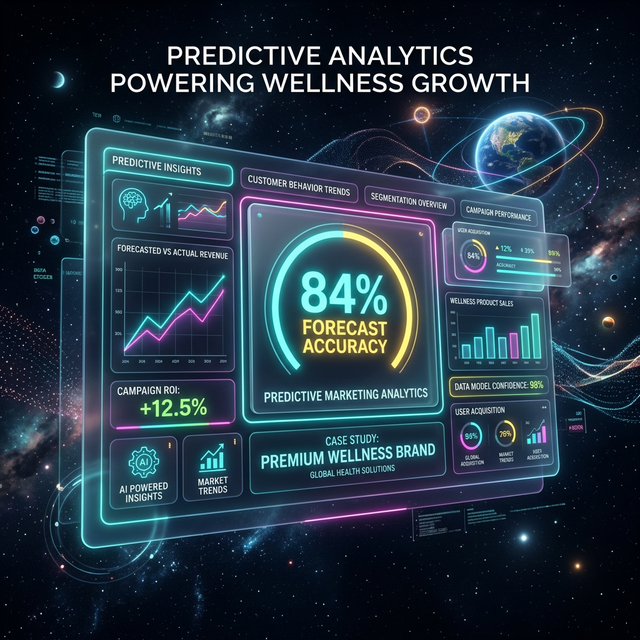
84%
Forecast Accuracy
465%
Revenue Growth
TL;DR
A premium lifestyle and wellness brand on the west coast transitioned from manual, intuition-driven marketing to a fully AI-powered predictive analytics platform over six weeks. By unifying fragmented data, implementing machine learning campaign forecasting, and automating optimization workflows, the brand achieved 84% campaign forecast accuracy, 465% revenue growth, an 81% reduction in customer acquisition cost, and 4.2x ROAS — transforming marketing operations from a cost center into a measurable growth engine.
The Challenge: Marketing on Intuition in a Data-Rich World
A premium lifestyle and wellness brand operating on the west coast had built a loyal customer base through exceptional service quality. But behind the scenes, their marketing operation was running almost entirely on intuition. Campaign budgets were allocated based on past habits rather than forward-looking data. Performance reviews happened weekly at best, meaning optimization decisions were always chasing results rather than anticipating them. There was no system in place to predict how a campaign would perform before it launched — and no unified view of data to support one.
The consequences were measurable and compounding. The brand's customer acquisition cost had climbed to $150 — an unsustainable figure for a business operating with approximately $2K in monthly ad spend. Manual reporting consumed enormous time each week, yet still produced incomplete insights because data lived in disconnected systems. Attribution gaps meant that winning channels went unrecognized and underinvested while underperformers continued receiving budget. The brand needed a fundamental shift: from reactive marketing operations to a predictive, AI-powered analytics platform built for growth.
Key Metrics: Before and After the Predictive Analytics Transformation
Campaign Forecast Accuracy
Revenue Growth
Customer Acquisition Cost Reduction
Return on Ad Spend
Attribution Recovery
Full-Journey Tracking Coverage
Customer Lifetime Value Improvement
Data Collection Growth
Our Approach: Predictive Marketing Analytics as a Growth System
The strategic foundation of this engagement was treating predictive analytics not as a reporting upgrade, but as the central operating system for all marketing decisions. Rather than layering AI tools on top of broken processes, the team began by rebuilding the data infrastructure from the ground up. Every campaign signal, customer interaction, and attribution touchpoint needed to flow into a single unified platform before any forecasting model could produce reliable outputs. This sequencing — infrastructure first, intelligence second, automation third — was non-negotiable.
The approach was organized into three distinct phases spanning six weeks. Phase one established the data foundation and unified platform. Phase two deployed the predictive campaign planning engine and automated optimization workflows. Phase three activated the full marketing operations automation platform, including intelligent resource allocation, real-time anomaly detection, and executive intelligence dashboards. Each phase had clear deliverables and validation checkpoints before the next began — ensuring the predictive models were trained on clean, reliable data from day one.
Budget Allocation Without Data
The Challenge
Marketing spend distributed by habit and intuition, with no forward-looking model to assess likely return before commitment.
Our Solution
AI-powered predictive budget allocation engine modeling expected ROAS and CAC outcomes for each channel before spend is deployed.
- +Eliminated wasted spend on low-probability channels
- +CAC reduced from $150 to $28
- +ROAS improved to 4.2x
Attribution Gaps from Privacy Restrictions
The Challenge
Browser privacy restrictions blocking 30–40% of conversion signals, causing systematic underattribution of winning campaigns.
Our Solution
Privacy-compliant enhanced conversion tracking with SHA-256 hashed first-party data and cross-device identity resolution.
- +35% of lost conversions recovered
- +95% tracking coverage maintained
- +Reliable data feeding forecast models
Reactive Campaign Optimization
The Challenge
Performance issues identified days or weeks after they occurred, making optimization corrections costly and slow.
Our Solution
Real-time campaign monitoring with automated bid adjustments and predictive anomaly detection alerting teams before performance degrades.
- +84% forecast accuracy enabling pre-launch adjustments
- +78% prediction confidence on live campaigns
- +Optimization speed shifted from weekly to real-time
Fragmented Customer Data
The Challenge
Customer journey data scattered across disconnected platforms with no unified view of behavior, preferences, or value.
Our Solution
Centralized customer data platform with automated ETL pipelines unifying all signals into a single source of truth.
- +2,000% growth in structured data collection
- +400% improvement in customer lifetime value
- +135+ monthly customers tracked with full journey visibility
Implementation Deep Dive: Three Phases to Predictive Intelligence
Phase one — Marketing Operations Intelligence Foundation — took two weeks and focused entirely on data infrastructure. The team built a unified marketing data platform consolidating signals from over a dozen previously disconnected sources, growing structured data collection by 2,000%. A predictive analytics engine was configured with machine learning forecasting models trained on historical campaign performance, market conditions, and competitive landscape signals. Real-time executive dashboards were deployed alongside an automated reporting system capable of generating AI-written insights and strategic recommendations without manual intervention.
Before & After
Customer Acquisition Cost
Before
$150
After
$28
81% reduction
Campaign Forecast Accuracy
Before
No forecasting capability
After
84%
84% accuracy from zero baseline
Return on Ad Spend
Before
Untracked / underattributed
After
4.2x
4.2x ROAS with full attribution
Attribution Coverage
Before
Significant conversion loss from privacy restrictions
After
95%
35% of lost conversions recovered
Monthly Customer Volume
Before
Inconsistent, untracked
After
135+
135+ monthly customers with full journey tracking
Monthly Booking Volume
Before
Dependent on word-of-mouth
After
100+
100+ monthly bookings through optimized campaigns
Data Collection
Before
Fragmented across disconnected systems
After
Unified platform
2,000% growth in structured data collection
Customer Lifetime Value
Before
Baseline
After
5x baseline
400% improvement
Phase two introduced automated campaign operations over the following two weeks. A predictive campaign planning system enabled the team to forecast campaign performance and simulate budget allocation outcomes before any spend was committed. Cross-channel orchestration unified campaign management across all active marketing platforms, while the performance prediction engine provided pre-launch forecasts with 78% prediction confidence. Automated bid adjustments and audience targeting optimizations began running in real-time, replacing the weekly manual review cycle that had previously delayed every optimization decision by seven or more days.
Phase three completed the platform with a comprehensive marketing operations automation layer. An AI-driven workflow automation engine handled routine marketing tasks that had previously consumed significant team bandwidth. Intelligent resource allocation tools optimized both budget distribution and operational focus based on predicted return. Real-time performance monitoring with automated anomaly detection ensured that underperforming campaigns triggered alerts and corrective workflows immediately. By the end of week six, the brand had transitioned from a manual, reactive marketing function to a fully automated predictive intelligence operation.
Technical Architecture: The Systems Behind 84% Forecast Accuracy
The core of the platform was a multi-stage predictive analytics engine that processed campaign configurations through a structured sequence: feature extraction from campaign parameters, historical performance pattern analysis, real-time market condition assessment, competitive landscape evaluation, and finally machine learning model inference. Each stage fed the next, producing a campaign performance forecast accompanied by optimization recommendations ranked by expected impact and a risk assessment scoring potential failure modes before launch. The output was not just a prediction — it was an actionable brief the team could execute against.
Attribution integrity was addressed through a privacy-compliant conversion tracking architecture. Enhanced conversion tracking used SHA-256 hashing to transmit first-party customer data — including email addresses and phone numbers — without exposing raw personally identifiable information. A cross-device identity resolution engine applied three matching tiers: deterministic matching for known users, probabilistic matching for high-confidence candidates, and ML-assisted resolution for ambiguous signals. This layered approach recovered 35% of previously lost conversions while maintaining 95% tracking coverage across the full customer journey, even in privacy-restricted browser environments.
-Reactive, Fragmented, and Flying Blind
- -Customer acquisition cost sitting at $150 per new customer
- -Campaign optimizations delayed by weekly manual review cycles
- -No attribution for a significant share of actual conversions
- -Budget allocated by intuition with no forecast validation
- -Data living in disconnected systems with no unified view
- -Monthly bookings dependent on word-of-mouth and inconsistent spend
-Predictive, Automated, and Compounding
- -Customer acquisition cost reduced to $28 — an 81% decrease
- -Real-time campaign optimization replacing weekly lag
- -35% of lost conversions recovered with 95% tracking coverage
- -Every budget decision validated by 84% accurate forecast models
- -2,000% growth in structured data collection from unified platform
- -100+ monthly bookings and 135+ monthly customers served
Results & Business Impact: Verified Outcomes from the Predictive Analytics Rollout
The most significant outcome of the engagement was the 465% revenue growth achieved after the predictive analytics platform reached full operational maturity. This growth was not driven by a single optimization — it was the compound effect of more accurate budget allocation, faster campaign optimization cycles, recovered attribution revealing high-performing channels, and a dramatically lower cost to acquire each new customer. With CAC dropping from $150 to $28, the brand's marketing budget went substantially further, enabling reinvestment into channels the forecasting models had identified as highest-return.
Customer lifetime value improved by 400%, reflecting not just acquisition efficiency gains but deeper engagement made possible by richer customer data. With 2,000% growth in structured data collection from the unified platform, the brand developed a far clearer picture of customer behavior, service preferences, and repeat booking patterns. This intelligence fed back into the predictive models, improving forecast accuracy over time and enabling increasingly precise personalization at scale. The 607% growth in review volume further validated that operational improvements were translating into genuine customer satisfaction — not just marketing metrics.
Customer Acquisition Cost Before
Customer Acquisition Cost After
Return on Investment
Organic Traffic Growth
Review Volume Growth
Monthly Bookings Achieved
Prediction Confidence Score
Monthly Ad Spend at Engagement Start
Key Takeaways: What Made Predictive Marketing Analytics Work Here
Implementation Timeline
Phase 1: Marketing Operations Intelligence Foundation
2 weeksBuilt the unified data platform consolidating signals from previously disconnected sources, achieving 2,000% growth in structured data collection. Deployed the predictive analytics engine with ML forecasting models, real-time executive dashboards, and an automated reporting and insights generation system. Established a single source of truth for all marketing data as the prerequisite for reliable forecasting.
Phase 2: Automated Campaign Operations
2 weeksDeployed the predictive campaign planning system with pre-launch performance forecasting delivering 78% prediction confidence. Built cross-channel campaign orchestration and automated bid adjustment workflows. Replaced weekly manual optimization reviews with real-time automated campaign adjustments informed by ML performance forecasts.
Phase 3: Marketing Operations Automation Platform
2 weeksActivated the comprehensive workflow automation engine handling routine marketing tasks. Deployed intelligent resource allocation tools for budget and operational optimization. Implemented real-time performance monitoring with anomaly detection and automated alerts. Completed the strategic optimization platform with continuous AI-driven improvement cycles.
*Key Takeaways
- 1Data unification is the prerequisite — predictive models built on fragmented data produce unreliable forecasts. The 2,000% growth in structured data collection was the foundation every other result was built on.
- 2Attribution recovery is not optional. Recovering 35% of lost conversions fundamentally changed which channels received budget, directly contributing to the CAC reduction from $150 to $28.
- 3Forecast accuracy compounds over time. The 84% campaign forecast accuracy was the result of iterative model training on clean, unified data — not a one-time configuration. Teams must commit to ongoing model refinement.
- 4Real-time optimization replaces weekly guesswork. Shifting from weekly manual review cycles to automated real-time adjustments removed the 7–14 day lag that had previously allowed underperforming campaigns to drain budget before correction.
- 5CAC reduction amplifies every other metric. When the cost to acquire a customer drops by 81%, the same ad budget produces dramatically more customers — which drives revenue growth, CLV improvement, and review volume simultaneously.
- 6Predictive confidence scores inform risk management. The 78% prediction confidence metric gave the team a transparent signal of model certainty, enabling them to apply human review selectively to lower-confidence forecasts rather than reviewing everything manually.
- 7Small budgets benefit disproportionately. Starting from approximately $2K in monthly ad spend, the platform eliminated nearly all wasted spend — making prediction-driven allocation more impactful at this scale than at larger budgets with more margin for error.
Lessons Learned: What We Would Do the Same — and What We'd Do Differently
The phased implementation sequence — infrastructure, then intelligence, then automation — proved essential. Teams that attempt to deploy predictive models before data infrastructure is clean and unified consistently produce unreliable forecasts that erode stakeholder confidence in the platform. The six-week timeline with clear phase gates allowed the brand's team to validate outputs at each stage before committing to the next layer. This approach also meant that if data quality issues emerged in phase one, they were caught before they could contaminate the machine learning models trained in phase two.
If we were to run this engagement again, we would prioritize the enhanced conversion tracking setup even earlier — ideally as a parallel workstream during phase one rather than sequentially after. The 35% attribution recovery it produced was instrumental in validating forecast model outputs, and having that data flowing sooner would have accelerated model training. We would also invest more heavily in stakeholder education around prediction confidence scores in the first two weeks. Teams unfamiliar with probabilistic forecasting sometimes dismiss predictions below a certain confidence threshold rather than using confidence levels as a risk-weighting input to decisions.
“We went from making marketing decisions based on what felt right last week to knowing — with actual confidence scores — what each campaign is likely to produce before we spend a dollar. Seeing our customer acquisition cost drop from $150 to $28 while bookings climbed past 100 per month made it impossible to argue with the data. Predictive analytics isn't a reporting tool. It's how we run the business now.”
— Marketing Director, Premium Lifestyle & Wellness Brand, West Coast
Who Should Implement Predictive Analytics Marketing: A Decision Framework
Not every brand is at the same readiness level for a full predictive analytics platform. The most important prerequisite is a willingness to invest in data infrastructure before expecting intelligence outputs. Brands that have never unified their marketing data — or that are operating primarily on vanity metrics — will need to treat phase one as a multi-month commitment rather than a two-week sprint. The reward for that investment, as this case study demonstrates, is a compounding growth engine that gets more accurate the longer it runs.
You're spending on ads but can't tell which channels are working
The Challenge
Attribution gaps are causing systematic misallocation of marketing budget, with winning channels underinvested and losing channels draining spend.
Our Solution
Start with enhanced conversion tracking and attribution recovery. Establish 95% tracking coverage before layering on predictive models.
- +35% attribution recovery baseline
- +Accurate channel performance signals
- +Budget reallocation grounded in real conversion data
Your customer acquisition cost is unsustainably high
The Challenge
CAC has grown to the point where marketing is not generating profitable customer relationships, especially on modest budgets.
Our Solution
Deploy predictive audience targeting and automated bid optimization guided by ML performance forecasts to eliminate wasted spend at the impression level.
- +CAC reduction from $150 to $28 demonstrated in this engagement
- +81% reduction achievable with unified data and real-time optimization
- +250% ROI from optimized spend allocation
Your team spends more time on reporting than on strategy
The Challenge
Manual data consolidation and reporting is consuming team bandwidth that should be invested in campaign strategy and creative development.
Our Solution
Automate reporting and insight generation with AI-driven dashboards that surface anomalies, trends, and recommendations without manual synthesis.
- +Reporting automation freeing strategic capacity
- +Real-time dashboards replacing weekly manual reviews
- +Executive-ready insights generated continuously
Frequently Asked Questions About Predictive Marketing Analytics
The questions below address the most common decision-making challenges brands face when evaluating whether predictive analytics marketing is the right investment for their current stage of growth. Each answer is grounded in the specific outcomes and technical approaches documented in this case study.
Technology Stack
Frequently Asked Questions
Predictive marketing analytics uses machine learning models to forecast future campaign performance, customer behavior, and revenue outcomes before they happen. Traditional analytics is descriptive — it tells you what already occurred. Predictive analytics tells you what is likely to happen next, enabling proactive budget allocation, audience targeting, and campaign adjustments rather than reactive corrections after performance has already degraded.
In this engagement, the predictive analytics platform achieved 84% campaign forecast accuracy and maintained a 78% prediction confidence score across live campaign assessments. Accuracy depends heavily on data quality, historical volume, and model training. Brands with unified first-party data and consistent historical campaign records typically see the strongest forecasting performance within the first 90 days of implementation.
The CAC reduction from $150 to $28 was driven by three compounding factors: precise predictive audience targeting that eliminated wasted spend, real-time bid optimization guided by ML performance forecasts, and attribution recovery that identified which channels were actually driving conversions. With 35% of previously lost conversions recovered, budget reallocation decisions became far more accurate, eliminating spend on underperforming channels.
This full implementation — covering data unification, predictive engine deployment, automated campaign management, and executive dashboards — was completed in six weeks across three phased sprints. The first meaningful forecast outputs were available at the end of week two once the unified data platform was operational. Ongoing model refinement continues after launch, with prediction accuracy typically improving over the first 60 to 90 days.
At minimum, brands need a centralized data pipeline connecting advertising platforms, CRM, and website analytics. This engagement began by building a unified data platform ingesting signals from disconnected systems and growing data collection by 2,000%. Brands with existing CDP infrastructure or clean GA4 setups can accelerate the foundation phase, but the unification step is non-negotiable — fragmented data produces unreliable forecasts.
Yes. This case study involved a brand operating with approximately $2K in monthly ad spend — a relatively modest budget. The predictive platform's value at that scale comes from eliminating wasted spend rather than optimizing massive budgets. With CAC dropping from $150 to $28 and ROAS reaching 4.2x, even constrained budgets compound meaningfully when every dollar is allocated by forecast data rather than intuition.
Predictive campaign forecasting improves attribution by identifying which channel combinations and sequencing patterns correlate most strongly with conversion outcomes before spend is committed. In this engagement, 35% of previously unattributed conversions were recovered through enhanced tracking, and 95% tracking coverage was maintained across the full customer journey. This created a reliable feedback loop where forecast models could be validated against actual outcomes and continuously retrained.
Related Case Studies
Ready to achieve similar results?
Get a custom growth plan backed by AI-powered systems that deliver measurable ROI from day one.
Start Your Growth Engine