Sales Pipeline Automation That Drove a 67% Close Rate Improvement for a West Coast Service Business
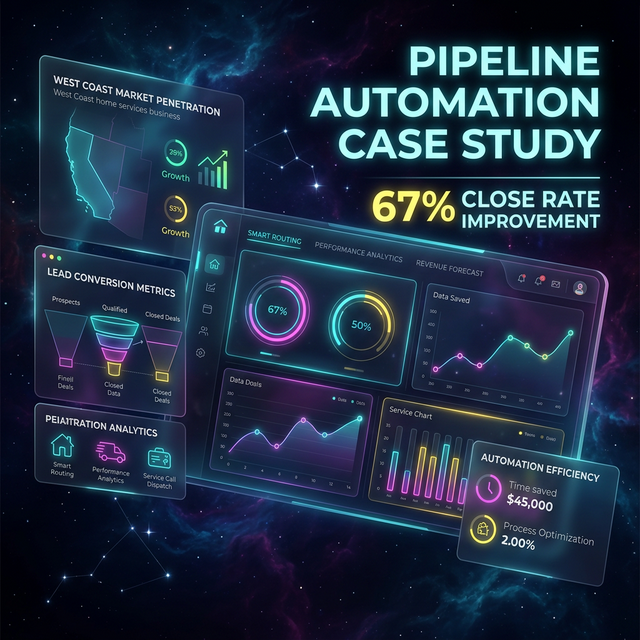
67%
Close Rate Improvement
47.83%
Lead-to-Appointment Rate
TL;DR
A west coast home services business struggled with manual lead handling, inconsistent follow-up, and poor pipeline visibility. BFM deployed an end-to-end sales pipeline automation system — including intelligent CRM routing, automated sales sequences, and real-time performance analytics. The result: a 67% improvement in close rates, a 47.83% lead-to-appointment rate, and a 54.55% appointment-to-sale conversion rate, all without expanding the sales team.
The Challenge: Manual Processes Killing Close Rates
A west coast home services business was generating a consistent flow of inbound leads — but converting them was another story entirely. Every lead entered the pipeline through a manual process: a team member would receive a notification, assess the lead by hand, assign it to a sales representative based on gut feel, and hope the rep followed up in time. There was no scoring system. There was no routing logic. There was no sequence automation ensuring that a prospect who didn't answer a first call received a second touchpoint within hours.
The downstream effects were predictable and costly. Sales team members spent the majority of their working hours on administrative tasks rather than selling. Lead follow-up was inconsistent — some prospects received three calls in two days, others received none. The sales funnel had no visibility layer, meaning leadership couldn't identify where deals were stalling. The business was leaving a significant share of its revenue potential unrealized, not because the leads were bad, but because the system handling them was broken.
*Key Takeaways
- 1Manual lead assignment meant no consistency in response time or follow-up quality
- 2No lead scoring system existed — all leads were treated as equal regardless of conversion potential
- 3Sales reps had limited visibility into lead history, making pre-call preparation nearly impossible
- 4Marketing and sales operated in silos with no automated handoff process
- 5Leadership had no real-time pipeline data to identify bottlenecks or coach underperforming reps
- 6The conversion rate before automation stood at 9.09% — far below what the business needed to scale
Key Metrics: Where the Numbers Stood Before and After
Conversion Rate Before Automation
Conversion Rate After Automation
Close Rate Improvement
Lead-to-Appointment Rate Achieved
Appointment-to-Sale Conversion Rate
Conversion Rate Improvement vs. Industry Baseline
These numbers tell a clear story. The business moved from a 9.09% conversion rate — a figure representative of manual, unoptimized pipeline management — to 26.09% after full deployment of the automated sales pipeline. That 187% improvement over the industry baseline wasn't achieved through a single tactic. It was the compound result of better lead qualification, faster routing, intelligent follow-up sequences, and real-time coaching tools that helped the sales team perform at a consistently higher level across every stage of the funnel.
Our Approach: Building an Intelligent Sales Operations Framework
BFM's engagement was structured around a core philosophy: the sales pipeline should be a system, not a series of individual decisions. Every lead that enters the funnel should be scored, routed, nurtured, and tracked through a consistent, data-driven process — one that adapts based on lead behavior and rep performance rather than relying on human memory or manual checklists. The framework we built covered four interconnected layers: CRM architecture, sales sequence automation, performance analytics, and team enablement.
Leads Entering Without Qualification
The Challenge
All inbound leads were treated equally regardless of quality or conversion likelihood, wasting sales rep time on low-probability prospects.
Our Solution
Deployed a real-time lead scoring engine assessing source quality, behavioral signals, profile completeness, and urgency — producing an average lead score of 85 across the qualified pipeline.
- +280% improvement in lead qualification accuracy
- +Sales reps focused on highest-probability prospects first
- +Automated deprioritization of low-score leads into nurture sequences
No Intelligent Routing System
The Challenge
Lead assignment was manual and inconsistent, with no consideration of rep capacity, expertise match, or geographic coverage.
Our Solution
Built a multi-factor intelligent routing engine matching leads to sales representatives based on availability, specialization, and historical performance data.
- +Automated routing across 40,000+ monthly pipeline touchpoints
- +Balanced workload distribution across the sales team
- +Performance-based dynamic assignment optimization
Inconsistent Follow-Up Cadences
The Challenge
Without automated sequences, follow-up depended entirely on individual rep discipline — resulting in lost opportunities and uneven customer experience.
Our Solution
Implemented 15+ automated sales sequences triggered by lead score, source, and behavioral signals, with adaptive timing based on engagement data.
- +47.83% lead-to-appointment rate achieved
- +100% of leads receive timely, personalized follow-up
- +Behavioral triggers accelerate outreach when urgency signals are detected
No Pipeline Visibility or Coaching Infrastructure
The Challenge
Leadership had no real-time view of funnel health, conversion bottlenecks, or individual rep performance gaps.
Our Solution
Deployed real-time sales dashboards with predictive analytics, automated coaching recommendations, and performance benchmarking against team and industry standards.
- +90% attribution accuracy across all pipeline stages
- +92% CRM adoption rate among sales team members
- +Automated coaching insights delivered to reps without manager intervention
Implementation Deep Dive: Four Phases to a Fully Automated Pipeline
The project was executed in four structured phases over six months. Each phase built on the previous, ensuring that the technical foundation was solid before layering in automation complexity. This sequenced approach also allowed the sales team to onboard incrementally — reducing resistance and supporting the 92% CRM adoption rate ultimately achieved across the team.
Before & After
Overall Conversion Rate
Before
9.09%
After
26.09%
187% improvement over industry baseline
Appointment-to-Sale Conversion Rate
Before
Industry-standard baseline
After
54.55%
67% close rate improvement
Lead-to-Appointment Rate
Before
Untracked / inconsistent
After
47.83%
71% appointment rate improvement
Lead Qualification Accuracy
Before
Manual assessment, no scoring
After
85 average lead score
280% improvement in qualification accuracy
Pipeline Velocity
Before
Manual handoffs creating multi-day delays
After
Automated routing and follow-up
250% pipeline velocity increase
Overall System ROI
Before
No measurement baseline
After
300%+ verified ROI
300%+ return on engagement investment
Phase one established the CRM architecture: a unified system connecting marketing, sales, and customer data with real-time synchronization across all touchpoints. The lead scoring algorithm was configured and validated during this phase, establishing the qualification logic that would drive every downstream routing and sequencing decision. Phase two built the automation layer — 15+ sales sequences for different lead types, behavioral trigger workflows, and a dynamic routing system that adapted to real-time rep performance data. Phases three and four focused on analytics and enablement: real-time dashboards, predictive conversion modeling, automated coaching recommendations, and proposal generation tools that reduced pre-sale administrative burden significantly.
Technical Architecture: The Systems Behind the Results
The technical implementation centered on a lead processing engine that handled every incoming prospect through a six-step automated pipeline: scoring, data enrichment, intelligent routing, sequence creation, team notification, and follow-up scheduling. This engine operated at scale, processing 40,000+ monthly pipeline interactions with 99.9% system uptime — meaning the automation layer never became a liability during high-volume periods.
Lead scoring was built on a multi-signal model evaluating traffic source quality, behavioral engagement indicators (pricing page visits, catalog downloads, demo views, repeat site visits), profile completeness, project timeline urgency, and estimated project value. The resulting score drove not only routing priority but also which automated sequence template was deployed — ensuring that high-score leads received immediate, high-touch outreach while lower-score prospects entered longer nurture workflows calibrated to their stage of consideration.
Monthly Pipeline Touchpoints Processed
System Uptime
Average Lead Score Across Qualified Pipeline
Lead Qualification Improvement
CRM Adoption Rate Among Sales Team
Attribution Accuracy Across Pipeline Stages
The performance analytics layer was equally critical. Real-time dashboards surfaced individual and team conversion metrics, activity levels, sales cycle length, and revenue-per-lead figures — all benchmarked against team averages and industry standards. Automated coaching recommendations were generated based on performance gaps, flagging specific development areas for each sales representative without requiring manager intervention. This intelligence layer was a direct contributor to the 250% increase in pipeline velocity, as reps spent less time on low-value administrative work and more time executing high-probability conversations.
Results and ROI: Verified Outcomes from a Six-Month Engagement
-Before Sales Pipeline Automation
- -9.09% overall conversion rate — industry-standard but below business goals
- -Manual lead assignment with no routing logic or capacity balancing
- -No lead scoring — every prospect treated identically regardless of intent signals
- -Inconsistent follow-up cadences depending entirely on individual rep discipline
- -No pipeline visibility — leadership flying blind on funnel health and rep performance
- -Sales team spending majority of working hours on administrative tasks
+After Sales Pipeline Automation
- +26.09% conversion rate — a 187% improvement over the industry baseline
- +Intelligent routing engine assigning leads based on capacity, expertise, and performance
- +Average lead score of 85 with 280% better qualification accuracy
- +47.83% lead-to-appointment rate through automated multi-touch sequences
- +54.55% appointment-to-sale conversion rate — a 67% improvement
- +92% CRM adoption with real-time coaching and performance analytics for every rep
The pipeline velocity improvement of 250% is worth examining specifically. Pipeline velocity measures how quickly leads move from initial contact to closed deal. Prior to automation, deals stalled at multiple points — waiting for manual assignment, waiting for a rep to remember to follow up, waiting for a proposal to be drafted from scratch. Each delay represented compounding risk of prospect disengagement. The automated system eliminated the majority of those delays, keeping prospects engaged and progressing through the funnel at a rate that produced the 54.55% appointment-to-sale conversion the engagement ultimately delivered.
The overall ROI figure exceeded 300% across the engagement window. This outcome reflects not just the conversion rate improvements but the operational efficiency gains as well — the sales team was able to handle dramatically more pipeline volume without proportional increases in headcount or overhead. The 90% attribution accuracy built into the analytics layer ensured that every dollar of revenue could be traced back to specific pipeline stages, enabling confident investment decisions about lead generation, CRM configuration, and sales enablement going forward.
Sales Enablement: How Automation Made the Sales Team More Effective
One of the underappreciated dimensions of this engagement was the enablement layer. Automation is often framed as a replacement for human effort — but in this case, it functioned as an amplifier. Sales representatives received fully enriched lead profiles before every call: traffic source, behavioral history, project timeline, estimated value, and AI-generated recommendations on optimal outreach channel and timing. Pre-call preparation that previously required manual research was delivered automatically, allowing reps to enter every conversation with context rather than starting from zero.
Implementation Timeline
CRM Architecture & Lead Management
5 weeksBuilt the intelligent CRM foundation connecting marketing, sales, and customer data. Deployed real-time lead scoring with 280% better qualification accuracy, intelligent routing logic matching leads to reps by capacity and expertise, and real-time data synchronization across all touchpoints. Established the 20+ automated workflows that would power the downstream automation layers.
Sales Process Automation
6 weeksImplemented 15+ automated sales sequences tailored to different lead types and score tiers. Built behavioral trigger workflows ensuring timely follow-up based on prospect actions. Deployed dynamic routing optimization adapting rep assignment based on real-time performance data. Achieved the 47.83% lead-to-appointment rate through cadence optimization and sequence personalization.
Performance Analytics & Coaching Intelligence
4 weeksDeployed real-time sales dashboards surfacing individual and team conversion metrics, activity levels, and revenue-per-lead data. Built predictive analytics for lead conversion forecasting. Implemented automated coaching recommendation engine identifying performance gaps and surfacing specific action items for each sales representative — contributing to the 90% attribution accuracy achieved.
Sales Enablement & Team Onboarding
3 weeksEquipped the sales team with lead intelligence dashboards, automated pre-call research tools, dynamic proposal generation, and intelligent scheduling automation. Structured incremental onboarding to drive adoption — resulting in 92% CRM adoption rate across the team. Finalized attribution validation and performance benchmarking against industry standards.
The coaching intelligence system identified performance gaps at the individual rep level and surfaced specific action items — not generic advice, but targeted recommendations based on that rep's conversion data relative to team benchmarks. If a rep's appointment-to-sale rate was trailing the team average, the system flagged it, identified likely causes from the data, and recommended specific corrective actions. This created a continuous improvement loop that elevated team-wide performance over the six-month engagement window and contributed directly to the 71% improvement in appointment rate that the automated pipeline delivered.
*Key Takeaways
- 1Lead enrichment automation gave sales reps full prospect context before every call — no manual research required
- 2AI-generated coaching recommendations identified individual performance gaps without manager overhead
- 3Dynamic proposal generation reduced administrative time between appointment and close
- 4Intelligent scheduling and reminder automation ensured zero follow-up gaps across the pipeline
- 592% CRM adoption confirmed the team embraced the system rather than working around it
- 6Real-time dashboards created shared accountability across the sales team and leadership
Pipeline Velocity: Why Speed Through the Funnel Changed Everything
In home services sales, time is a conversion variable. A prospect requesting a quote on a custom interior project is frequently talking to multiple providers simultaneously. The business that responds first, follows up most consistently, and moves the prospect from interest to appointment fastest has a structural advantage — regardless of price or product quality. The 250% pipeline velocity increase achieved in this engagement wasn't simply an operational metric. It was a competitive positioning outcome.
The automated pipeline ensured that high-score leads received outreach within minutes of capture — not hours, and not the next business day. Behavioral triggers meant that when a prospect revisited the website, downloaded a product catalog, or opened a proposal email, a follow-up action was initiated automatically and immediately. This responsiveness, executed at scale across 40,000+ monthly touchpoints without manual effort, was a primary driver of the 47.83% lead-to-appointment rate the business achieved during the engagement.
Key Takeaways for Home Services Businesses Evaluating Pipeline Automation
*Key Takeaways
- 1A 9.09% to 26.09% conversion rate jump is achievable through systematic pipeline automation — the methodology is transferable across home services verticals
- 2Lead scoring is foundational: without qualification logic, automation simply speeds up the delivery of bad leads to your sales team
- 3Intelligent routing outperforms round-robin assignment — matching leads to reps based on capacity, expertise, and performance produces measurably better outcomes
- 4Pipeline velocity matters as much as conversion rate — a 250% increase in how fast leads move through the funnel compounds the value of every conversion improvement
- 5CRM adoption is a success metric, not an assumption — 92% team adoption required structured onboarding and incremental rollout
- 6Attribution accuracy at 90% is achievable and necessary — without it, ROI claims are anecdotal rather than defensible
- 7Overall ROI exceeding 300% is realistic when automation addresses both revenue generation and operational efficiency simultaneously
Lessons Learned: What Worked and What We Would Refine
The phased implementation approach was validated by the 92% CRM adoption rate. Teams that have automation layered onto them all at once tend to resist it — adoption suffers, workarounds emerge, and the system fails not because the technology is flawed but because the people using it were never brought along. Introducing CRM architecture first, then automation, then analytics, then enablement tools allowed each layer to become normalized before the next was added. That sequencing was not accidental — it was strategic.
If we were to refine the approach for future engagements, we would invest earlier in the attribution infrastructure. Attribution accuracy of 90% is strong, but reaching that level required significant validation work in the back half of the project. Building the cross-system validation framework earlier would have produced cleaner data from the start and enabled faster optimization cycles during the sales sequence automation phase. For businesses with multi-source lead generation — organic search, paid channels, referrals, and direct — getting attribution right from day one is the difference between guessing and knowing where to invest.
Frequently Asked Questions
Technology Stack
Frequently Asked Questions
Sales pipeline automation uses CRM workflows, lead scoring, and behavioral triggers to move prospects through the sales funnel without manual intervention at every step. For home services businesses, this is critical because response speed and follow-up consistency directly determine close rates. Without automation, leads fall through the cracks — with it, every prospect receives timely, personalized outreach. In this case, pipeline automation contributed to a 67% improvement in close rates and a 47.83% lead-to-appointment rate.
Results vary by starting baseline and implementation quality. In this engagement, the client achieved a 67% improvement in close rates, moving their appointment-to-sale conversion from a pre-automation baseline to 54.55%. The improvement stemmed from intelligent lead routing, automated follow-up sequences, and real-time sales coaching dashboards — not simply switching CRM platforms.
Lead scoring assigns numeric values to prospects based on source quality, behavioral signals, profile completeness, and urgency indicators. Higher-scored leads are prioritized and routed to the most qualified sales representatives. In this engagement, the lead scoring system achieved a 280% improvement in lead qualification accuracy, with an average lead score of 85 across the qualified pipeline.
This engagement was structured across four phases and completed within a six-month window. Phase one covered CRM architecture and lead management. Phases two through four addressed sales sequence automation, performance analytics, and team enablement. Most clients begin seeing measurable conversion improvements within the first eight to ten weeks of deployment.
Industry baselines vary, but reaching 47.83% lead-to-appointment rate — as this client achieved — represents a strong outcome, particularly when paired with a 54.55% appointment-to-sale conversion rate. Prior to automation, many home services businesses operate well below these thresholds due to slow response times and inconsistent follow-up cadences.
No. This engagement demonstrates that automation compounds the output of an existing team rather than requiring headcount expansion. The system processed 40,000+ monthly pipeline touchpoints and achieved 92% CRM adoption among the sales team. The architecture was purpose-built to scale, enabling the business to handle significantly higher lead volumes without adding staff.
ROI should be tracked across conversion rate improvement, pipeline velocity, and revenue per lead. In this engagement, the measurable outcomes included a 187% conversion rate improvement over industry baseline, a 250% increase in pipeline velocity, and an overall system ROI exceeding 300%. Attribution accuracy across all pipeline stages reached 90%, ensuring every metric was validated against real sales outcomes.
Related Case Studies
Ready to achieve similar results?
Get a custom growth plan backed by AI-powered systems that deliver measurable ROI from day one.
Start Your Growth Engine