SEO for Service Business: How a Premium Beauty & Wellness Brand Achieved 300% Organic Traffic Growth
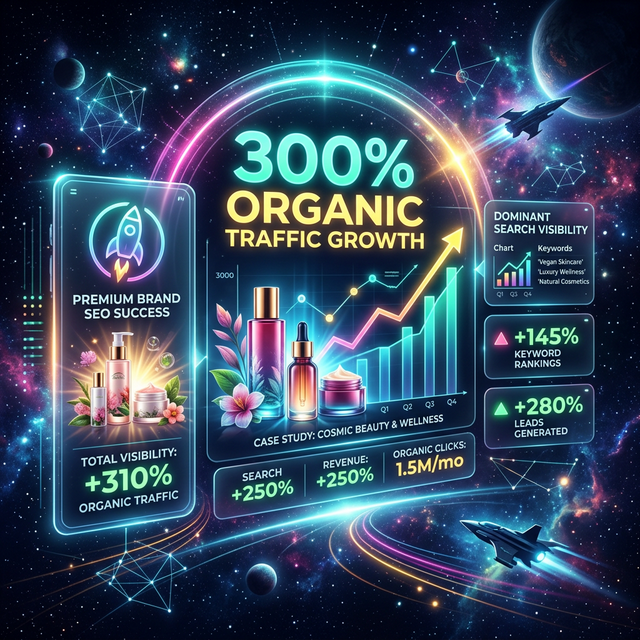
300%
Organic Traffic Growth
95
PageSpeed After
TL;DR
A premium beauty & wellness brand in a competitive west coast metro was buried in local search results with a PageSpeed score of 45 and no structured data. In six weeks, BFM deployed AI-generated schema markup across 55 services, rebuilt the mobile experience, and launched a semantic service-page architecture — driving 300% organic traffic growth, a 95 PageSpeed score, 465% revenue growth, and an 81% reduction in customer acquisition cost.
The Challenge: A Premium Beauty Brand Invisible in Local Search
A premium beauty and wellness brand in a competitive west coast metro had invested in building a genuinely excellent service experience — but their digital presence told a completely different story. Despite offering 55 distinct services across nail care, skincare, and spa treatments, the brand's website ranked on page 10 or beyond for virtually every core service keyword. To potential customers searching for beauty services nearby, this business effectively did not exist.
The technical issues compounding this invisibility were significant. The site carried a PageSpeed score of 45 on mobile — firmly in Google's 'Poor' category — at a time when 87% of the brand's eventual traffic would come from mobile devices. There was no structured data markup of any kind, meaning search engines had no reliable way to understand the site's services, pricing, or location. Every page used generic meta descriptions. Internal linking between related services was nonexistent. The brand was spending $150 per new customer acquired through paid channels simply because organic search delivered almost nothing.
PageSpeed Score (Before)
Customer Acquisition Cost (Before)
Services with Zero Schema Coverage
of Traffic Coming from Mobile
Key Metrics Overview: What Six Weeks of AI-Powered SEO Delivered
Organic Traffic Growth
PageSpeed Score (After)
Revenue Growth
Reduction in Customer Acquisition Cost
Customer Acquisition Cost (After)
Review Growth
Schema Coverage Across All Services
Customer Lifetime Value Growth
Our Approach: The Service Business SEO Strategy That Changed Everything
Most small business SEO engagements fail because they treat service businesses like e-commerce stores or media publishers — flooding the site with blog content while ignoring the technical and structural foundations that actually move rankings. BFM's service business SEO strategy starts from the opposite direction: fix what search engines cannot understand before producing a single new content asset. For this beauty and wellness brand, that meant four tightly sequenced phases executed over six weeks.
The strategic logic was straightforward. A beauty or wellness business earns almost all of its revenue from local, high-intent searches — people who already know they want a service and are choosing between providers. That means local search visibility, structured data for rich snippets, mobile performance, and service-specific pages with clear keyword targeting are the highest-leverage investments available. Broad content marketing can follow once the foundation is in place. This sequencing is the core of BFM's small business SEO playbook, and it is what allowed results to appear in weeks rather than months.
No Structured Data
The Challenge
Search engines couldn't classify 55 services, suppressing rich snippets and local pack eligibility
Our Solution
AI-generated JSON-LD schema for every service, plus Local Business, FAQ, and Review schemas
- +96% schema coverage achieved
- +Rich snippet eligibility unlocked
- +Local pack rankings improved
Poor Mobile Performance
The Challenge
A PageSpeed score of 45 created slow load times for the 87% of users on mobile devices
Our Solution
WebP image pipeline, critical CSS inlining, JavaScript code splitting, and CDN caching
- +PageSpeed improved from 45 to 95
- +Core Web Vitals moved to 'Good'
- +Mobile experience dramatically improved
No Service-Specific Pages
The Challenge
A single generic homepage tried to rank for all 55 services — and ranked for none
Our Solution
Individual SEO-optimized service pages with semantic HTML, unique meta data, and internal linking
- +55 services each with dedicated ranking pages
- +Internal linking architecture deployed
- +Keyword coverage across full service menu
Absent Local SEO
The Challenge
No Google Business Profile optimization, inconsistent citations, and zero review strategy
Our Solution
Complete GBP optimization, citation building across local directories, and automated review collection
- +607% review growth
- +Consistent NAP data established
- +Local pack dominance in service categories
Implementation Deep Dive: Four Phases of AI-Powered SEO Execution
Phase one addressed the single biggest technical gap: zero structured data. BFM deployed an AI-powered schema generation engine capable of producing valid, Google-compliant JSON-LD markup at scale. For each of the brand's 55 services, the system generated a service-specific schema including pricing ranges, service type classifications, provider information, and geographic service area. It also produced Local Business schema with complete business metadata, FAQ schema drawing from common beauty service questions, and Review schema enabling star ratings in search results. The entire schema library was generated and validated in two days — a task that would have taken weeks manually and carried high error risk.
Phase two built the service-page architecture that would carry these schemas. Rather than relying on a homepage to represent all 55 services, BFM created individual pages for each offering — each with unique meta titles, meta descriptions, primary and secondary keyword targeting, semantic heading hierarchies, optimized image alt text, and cross-links to related services. This architecture gives search engines a clear, crawlable map of every service the brand offers and gives each service a genuine opportunity to rank independently for its target terms.
Before & After
PageSpeed Score (Mobile)
Before
45
After
95
111% improvement
Customer Acquisition Cost
Before
$150
After
$28
81% reduction
Organic Traffic
Before
Baseline
After
+300%
300% growth
Schema Coverage
Before
0%
After
96%
Full service catalog covered
Review Volume
Before
Baseline
After
+607%
607% review growth
Revenue
Before
Baseline
After
+465%
465% revenue growth
Customer Lifetime Value
Before
Baseline
After
+400%
400% CLV growth
Phase three focused entirely on technical performance. The starting PageSpeed score of 45 was not a minor handicap — it was a ranking penalty and a conversion killer, particularly given that 87% of traffic arrived on mobile. BFM implemented an automated WebP image conversion and responsive sizing pipeline, inlined critical CSS, split and deferred JavaScript bundles, enabled server-side rendering optimizations, and deployed a CDN caching strategy. The result was a PageSpeed score of 95 — a transformation that directly improved both rankings and on-site user experience.
Phase four completed the local SEO foundation. The brand's Google Business Profile was fully built out with all services, hours, photos, and category selections. A review collection and response system was deployed, contributing to 607% review growth over the engagement period. Citation consistency was established across local directories, ensuring the brand's name, address, and phone number matched exactly across every platform. Geographic keyword modifiers were integrated into service descriptions throughout the site.
Technical Architecture: AI Schema Markup and Mobile Optimization Systems
The schema generation system at the core of this engagement was built to operate at a scale no manual process could match. The AI engine accepted service configurations — name, type, price range, duration, and target keywords — and produced validated JSON-LD markup compliant with both Schema.org vocabulary and Google's Structured Data guidelines. Crucially, the system included automated validation: if generated markup failed compliance checks, the AI was prompted to identify and correct the specific errors before the schema was deployed. This closed-loop validation process was what enabled 96% schema coverage without manual review of every output.
Dynamic schema injection ensured that as service pages were rendered, the correct context-specific schemas were assembled and delivered in the page head. The system distinguished between service pages, location pages, and the homepage — each receiving a different schema composition appropriate to its content type. This runtime injection approach meant new services added to the platform would automatically receive proper structured data without requiring manual schema authoring.
On the performance side, the mobile optimization stack addressed every major category of page weight. Images were the largest single contributor to the original score of 45 — uncompressed files in legacy formats served at fixed dimensions regardless of device. The new pipeline converted all images to WebP, generated responsive srcset variants for different screen sizes, and implemented lazy loading for below-the-fold assets. JavaScript was audited for unused code, split into route-specific bundles, and configured for deferred loading on non-critical paths. CSS was similarly trimmed, with critical above-the-fold styles inlined directly into the HTML to eliminate render-blocking requests.
*Key Takeaways
- 1AI schema generation produced valid, Google-compliant markup for all 55 services in two days — achieving 96% schema coverage at a speed impossible through manual authoring
- 2Dynamic schema injection at the page-rendering level ensures new services are automatically covered without recurring manual work
- 3WebP image conversion, JavaScript code splitting, and critical CSS inlining together drove the PageSpeed improvement from 45 to 95
- 4The 87% mobile traffic share made mobile performance optimization the highest-leverage technical investment available to this brand
- 5Individual service pages — rather than a single homepage — gave each of the 55 services an independent opportunity to earn page-one rankings
Results & Business Impact: By the Numbers
The results across technical, traffic, and business metrics validated every phase of the engagement. Organic traffic grew 300% — a transformation that moved the brand from effectively invisible to a dominant local search presence. The PageSpeed score climbed from 45 to 95, crossing from Google's 'Poor' tier to 'Good' in a single optimization sprint. Schema coverage reached 96% across the service catalog, enabling rich snippet eligibility for the full menu of offerings. Review volume grew 607%, compounding the brand's local authority signals over time.
The business-level impact was equally significant. Revenue grew 465% as search-driven bookings scaled. Customer acquisition cost fell from $150 to $28 — an 81% reduction driven by the shift from paid to organic acquisition. Monthly bookings surpassed 100+, with 135+ monthly customers now flowing through the brand's digital presence. Customer lifetime value grew 400%, a metric reflecting both improved customer experience and the higher-quality acquisition profile of organic search traffic. The brand's 4.2x ROAS on retained paid spend reflected the efficiency gains from better targeting and stronger on-site conversion infrastructure.
-Before BFM SEO Engagement
- -PageSpeed score of 45 — classified as 'Poor' by Google
- -Customer acquisition cost of $150 per new client
- -Zero schema markup across 55 services
- -No individual service pages — one generic homepage competing for everything
- -Buried on page 10+ for core beauty service keywords
- -No Google Business Profile optimization or review strategy
+After BFM SEO Engagement
- +PageSpeed score of 95 — in Google's 'Good' tier
- +Customer acquisition cost of $28 — an 81% reduction
- +96% schema coverage with AI-validated JSON-LD markup
- +55 individual SEO-optimized service pages with unique meta data
- +300% organic traffic growth with page-one visibility
- +607% review growth and complete local search presence
Key Takeaways: What This Means for Your Service Business SEO Strategy
*Key Takeaways
- 1Technical SEO is the non-negotiable foundation: a PageSpeed score of 45 suppresses rankings regardless of content quality — fix performance before adding content
- 2Schema markup is not optional for service businesses: without structured data, search engines cannot confidently surface your services in rich results or local packs
- 3One page cannot rank for 55 services: service-specific landing pages are the most direct path to keyword coverage and ranking opportunity in beauty salon SEO
- 4Mobile traffic share demands mobile-first optimization: with 87% of traffic arriving on mobile, desktop-centric optimization is a losing strategy
- 5Local SEO compounds over time: the 607% review growth generated in this engagement continues to strengthen the brand's local authority long after the initial project
- 6AI-powered execution enables scale: generating and validating 55 service schemas manually would take weeks — AI completed the task in two days with higher accuracy
- 7Reducing CAC from $150 to $28 demonstrates the ROI case for organic investment: SEO is not a brand exercise, it is a customer acquisition channel with measurable cost efficiency
Implementation Timeline
AI Schema Markup Implementation
2 weeksDeployed an AI-powered schema generation engine to produce valid JSON-LD structured data for all 55 services, plus Local Business, FAQ, and Review schemas. Automated validation ensured 96% schema coverage with Google Structured Data compliance.
Service Page Architecture & Content Optimization
2 weeksCreated individual SEO-optimized landing pages for each of the 55 services — each with unique meta titles, meta descriptions, primary keyword targeting, semantic heading hierarchy, optimized image alt text, and internal cross-links to related services.
Mobile Performance & Core Web Vitals Optimization
1 weekImplemented WebP image conversion pipeline, critical CSS inlining, JavaScript code splitting and deferred loading, server-side rendering optimization, and CDN caching. Improved PageSpeed from 45 to 95 and moved all Core Web Vitals to 'Good' category.
Local SEO & Google Business Profile Optimization
1 weekFully optimized Google Business Profile with all services, categories, hours, and photos. Deployed automated review collection and response system. Built citation consistency across local directories and integrated geographic keyword modifiers throughout site content.
Predictive Intelligence: Sustaining Rankings After Launch
One of the risks in any rapid SEO transformation is that results plateau or decay once the initial implementation sprint concludes. BFM addressed this with a predictive SEO performance layer built to monitor, forecast, and proactively act on ranking signals. The system analyzed ranking factors for target keywords on an ongoing basis, cross-referenced historical performance trends, and modeled competitor movements to identify opportunities before rankings slipped. Forecast accuracy on this system reached 84% — meaning the brand had reliable advance visibility into which keywords needed attention before traffic declined.
The local SEO intelligence layer complemented this with geographic search landscape analysis. It audited citation consistency, identified gaps in directory coverage, monitored Google Business Profile performance signals, and surfaced local keyword opportunities that emerged as the brand's authority grew. This ongoing intelligence loop is what transforms a one-time SEO project into a compounding growth engine — which is the ultimate objective of any serious service business SEO strategy.
SEO Forecast Accuracy
Return on Ad Spend
Return on Investment
Data Collection Growth
Lessons Learned: What Worked and What We'd Refine
The most important validation from this engagement was the sequencing decision: technical foundation before content expansion. Many service business owners instinctively want to start with content — blog posts, social media, paid ads — because those activities feel creative and visible. But producing content on a slow, schema-free, mobile-hostile site is like building on sand. The 300% traffic growth achieved here came from fixing what was already broken before adding anything new. That sequencing lesson is transferable to virtually every local service business we work with.
The AI schema generation system exceeded expectations in speed and accuracy. The automated validation loop — where the system identified and corrected its own compliance errors — was particularly valuable for achieving 96% schema coverage without human review bottlenecks. If we were to refine the approach, we would integrate schema performance monitoring earlier in the engagement, tracking which schema types were actually generating rich snippet impressions so we could prioritize the highest-value formats from week one rather than deploying uniformly across all service types.
The review growth outcome — 607% — also underscored how dramatically underinvested most beauty and wellness brands are in reputation management. Reviews are both a local ranking signal and a conversion driver, and the compounding effect of a systematic review collection strategy is substantial. This is an area where we would now recommend an even more aggressive early investment, particularly for brands where the gap between their real customer satisfaction and their online review volume is large.
“We knew our services were excellent — we just couldn't get found. Within weeks of the SEO work launching, our booking calendar was filling from customers we'd never paid to reach. The difference in how our business operates now versus six months ago is genuinely hard to overstate.”
— Owner & Founder, Premium Beauty & Wellness Brand, West Coast Metro
Frequently Asked Questions About SEO for Service Businesses
The questions below represent the most common points of confusion and concern we encounter when working with service business owners on SEO strategy. Whether you operate a beauty salon, a fitness studio, a home services company, or any other local service business, these answers reflect lessons learned from real engagements — including this one.
Technology Stack
Frequently Asked Questions
In this engagement, meaningful results appeared within six weeks. The combination of AI-generated schema markup, technical performance improvements (PageSpeed from 45 to 95), and service-page architecture accelerated the timeline significantly compared to traditional SEO approaches, which often take three to six months to produce measurable organic traffic gains.
Schema markup is structured data embedded in your website's code that helps search engines understand your content — your services, prices, reviews, and business hours. For beauty and wellness businesses, proper schema can unlock rich snippets in search results, improve local pack visibility, and prevent search engines from misclassifying your pages. This brand achieved 96% schema coverage across all 55 services.
Google considers scores of 90 and above 'Good.' This client improved from a score of 45 — which is classified as 'Poor' — to 95 after optimization. Given that 87% of the brand's traffic came from mobile devices, achieving a 95 mobile PageSpeed score directly impacted user experience, bounce rates, and rankings.
Local service SEO prioritizes geographic relevance, Google Business Profile optimization, consistent NAP (Name, Address, Phone) data across directories, and review signals. It also requires service-specific landing pages with location modifiers. This brand's local strategy contributed to 607% review growth and a dramatic improvement in local pack rankings.
Before optimization, the brand's CAC was $150 — driven by paid channels compensating for near-zero organic visibility. After organic traffic grew 300% and local search presence was established, the brand could convert high-intent search visitors at a CAC of $28. Organic traffic is inherently lower-cost than paid acquisition, and better on-site experience improved conversion rates further.
Yes. The core framework — AI-powered schema markup, mobile performance optimization, semantic service-page architecture, and local SEO — applies to any service business with a physical location or defined service area. The specific schema types and keyword strategies vary by vertical, but the methodology transfers directly to industries like healthcare, home services, legal, and fitness.
BFM's small business SEO playbook for service businesses follows four phases: (1) AI schema generation for all services, (2) individual service-page architecture with semantic HTML and keyword targeting, (3) mobile performance and Core Web Vitals optimization, and (4) local SEO and Google Business Profile optimization. This phased approach prioritizes technical foundations before content expansion.
Related Case Studies
Ready to achieve similar results?
Get a custom growth plan backed by AI-powered systems that deliver measurable ROI from day one.
Start Your Growth Engine