Local SEO for Service Business: How 44 Location Pages Drove 300% Organic Traffic Growth in 90 Days
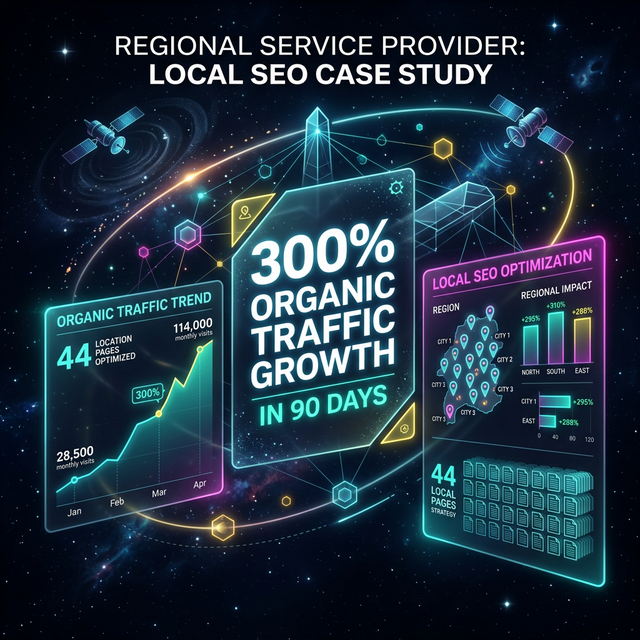
44
Location Pages
300%
Organic Traffic Growth
TL;DR
A regional home improvement provider serving a west coast metro area had only 3 static service pages and 500 monthly organic visitors. By building 44 AI-powered location-specific pages across 12 neighborhoods and pairing them with a structured educational content strategy, they achieved 300% organic traffic growth, a 187% improvement over industry-standard conversion rates, and a 2,368% SEO ROI within the project window.
The Challenge: A Regional Service Provider Invisible in Its Own Backyard
A west coast regional home improvement provider — specializing in custom interior door and closet system installation — had built a strong reputation through word-of-mouth referrals. But their digital footprint told a very different story. Their website contained only 3 static service pages, all of which used generic copy that made no mention of the specific neighborhoods they served. Against national home improvement chains with massive domain authority and regional competitors running paid campaigns, organic search was essentially a dead channel.
Monthly organic visitors had stagnated at just 500. Bounce rates on service pages hovered near 78%, indicating that visitors were landing and leaving without engaging — a clear signal that the content wasn't matching what local searchers actually wanted. The business was losing research-phase customers to competitors who had invested in location-specific content. Every neighborhood they served but hadn't claimed online was revenue left on the table. Manual content creation wasn't a realistic fix at scale. They needed a system — not a stopgap.
Monthly Organic Visitors at Baseline
Industry-Standard Conversion Rate
Target Location Pages to Build
Organic Traffic Growth Goal
Key Metrics: The Results at a Glance
Location Pages Deployed
Organic Traffic Growth
Conversion Rate Improvement Over Industry Standard
Lead-to-Sale Conversion Rate (After)
Lead-to-Appointment Rate from Organic Traffic
SEO ROI
Average Lead Score
Content Multiplication from Core Service Matrix
Review Growth During Implementation Window
Lead Qualification Improvement
Our Approach: Local Search Domination Through Programmatic SEO
The core strategic insight was straightforward but powerful: local searchers don't type generic queries. Someone in a northern suburb looking for closet door installation doesn't search for "closet doors" — they search for "closet door installation [their neighborhood]." Every neighborhood the provider served represented an untapped keyword cluster with purchase-intent traffic and relatively low competition. The solution was to build a scalable content architecture that could claim those keyword clusters systematically, rather than trying to outspend national competitors on broad terms.
The programmatic SEO approach mapped 4 core service categories against 12 high-value target neighborhoods, generating a service-location matrix of 48 page opportunities. Of those, 44 pages went live in the initial deployment — representing an 80x multiplication of the existing content footprint without a proportional increase in production cost. Each page was engineered to satisfy a unique local search intent, carry proper structured data, and integrate seamlessly with the site's internal linking architecture. This wasn't thin content generation — every page was built to rank and to convert.
No Local Search Presence
The Challenge
3 generic service pages competing against national chains with massive domain authority
Our Solution
44 location-specific pages targeting hyper-local keyword clusters across 12 neighborhoods
- +Claimed untapped local keyword clusters with purchase intent
- +Reduced head-term competition by targeting long-tail location queries
- +Established local authority signals in Google Maps and local packs
Poor Conversion Quality
The Challenge
Generic content attracting low-intent visitors with a 9.09% baseline conversion rate
Our Solution
Intent-matched location pages filtering traffic to high-readiness local buyers
- +Conversion rate improved from 9.09% to 26.09%
- +Lead-to-appointment rate reached 47.83%
- +Average lead score climbed to 85
Manual Content Creation Bottleneck
The Challenge
Time-consuming, inconsistent manual writing process unable to scale across locations
Our Solution
AI-powered content pipeline with quality scoring and human editorial oversight
- +80x content multiplication from core service-location matrix
- +Consistent brand voice and SEO optimization at scale
- +Framework extensible to additional neighborhoods without rebuilding
Implementation Deep Dive: Four Phases to Local Search Domination
The implementation was structured across four sequential phases, each building on the last. Phase 1 focused on strategic research and location analysis — mapping neighborhoods by search volume, competitive density, and revenue potential to prioritize the 12 target areas. Keyword research identified 200+ long-tail search terms combining service categories with specific neighborhood names, giving the content team a precise targeting framework before a single page was written.
Before & After
Monthly Organic Visitors
Before
500
After
500 + 300% growth
300% organic traffic growth
Lead-to-Sale Conversion Rate
Before
9.09% (industry standard)
After
26.09%
187% improvement over industry standard
Lead Qualification Rate
Before
Baseline (unscored leads)
After
85 average lead score
280% lead qualification improvement
Lead-to-Appointment Rate
Before
Below industry benchmark
After
47.83%
47.83% appointment conversion from organic traffic
SEO Return on Investment
Before
No measurable organic ROI
After
2,368% SEO ROI
2,368% ROI with 300%+ overall return
Review Growth
Before
Baseline review volume
After
250% review growth
250% increase in customer reviews during implementation window
Phase 2 established the technical architecture: a dynamic URL structure organized around service and location slugs, enabling clean, crawlable paths for each service-neighborhood combination. Schema markup — including LocalBusiness, Service, and FAQ structured data — was baked into the page template so that every page launched with full structured data from day one. Static site generation pre-built all 44 pages at deployment time, ensuring fast load speeds and reliable crawl performance. The system maintained 99.9% uptime throughout the rollout.
Phase 3 activated the AI content pipeline. Each page brief pulled service details and neighborhood context from a centralized database, then passed that data through an AI generation layer that produced unique, locally relevant copy. A quality scoring system flagged any output that didn't meet readability or SEO thresholds before human review. Phase 4 completed the loop with a full analytics implementation: custom tracking dimensions for service-location combinations, conversion event tracking for lead attribution, and a real-time performance dashboard for ongoing optimization.
Technical Architecture: The System Behind the Scale
The technical foundation was built on a modern JavaScript framework using an App Router pattern, with a dynamic route structure organized as /[service]/[location]/. This clean URL architecture ensured that search engines could parse the relationship between service and geography directly from the URL, reinforcing the local relevance signals that neighborhood SEO depends on. Trailing slashes were enforced consistently across all 44 pages to eliminate crawl duplication issues that often undermine programmatic SEO deployments at scale.
Content data was stored in a cloud database with service-role security, allowing the AI generation pipeline to pull structured inputs and return consistent outputs without exposing sensitive configuration to the client-side layer. The hosting environment was configured with a reverse proxy for performance optimization, and a smart caching system stored generated content between deployments to minimize build times as the page count grew. The entire stack was engineered for extensibility — the same framework that supported 44 pages at launch is capable of scaling to additional neighborhoods without a rebuild.
+Programmatic Local SEO Architecture
- +44 unique location pages targeting specific neighborhood search intent
- +Clean /[service]/[location]/ URL structure for maximum crawlability
- +Schema markup deployed on every page at build time
- +Static generation for fast load speeds and 99.9% uptime
- +AI content pipeline with human quality oversight
- +Custom analytics tracking per service-location combination
-Generic Single-Page Service Approach
- -3 static pages competing for broad, high-competition keywords
- -No location signals for Google Maps or local pack eligibility
- -Generic copy failing to match neighborhood-specific search intent
- -500 monthly visitors stagnating with no growth mechanism
- -Manual content creation unable to scale across service areas
- -No conversion tracking or lead attribution by channel
Results & Impact: What 44 Pages Delivered
The traffic results were unambiguous. Organic visitors grew by 300% from the 500-visitor baseline, with growth accelerating as more pages accumulated ranking history and internal linking authority compounded across the site. The local pack visibility gains were equally significant — the provider earned featured placement in the majority of their 12 target neighborhoods, converting a previously invisible brand into a dominant local presence across the metro area.
The conversion data was the most commercially significant outcome. The lead-to-sale conversion rate reached 26.09% — compared to the industry standard of 9.09% — representing a 187% improvement. This wasn't a marginal gain; it was a structural shift driven by the quality of the traffic. Location-page visitors arrive with specific, high-intent queries. They already know their neighborhood, know the service they want, and are typically in an active buying window. The 47.83% lead-to-appointment rate from organic traffic confirmed that the content was attracting the right buyers, not just more visitors. The overall SEO ROI reached 2,368%.
Organic Traffic Growth
Lead-to-Sale Conversion Rate (After)
Industry-Standard Conversion Rate (Before)
Improvement Over Industry Standard
Lead-to-Appointment Rate from Organic
SEO ROI
Overall ROI
Lead Qualification Improvement
Lead Quality: The Hidden Multiplier in Neighborhood SEO
Raw traffic growth is a vanity metric if the leads it generates don't convert. What distinguished this implementation was the parallel improvement in lead quality. The average lead score reached 85, reflecting that organic visitors were arriving pre-qualified by the specificity of their search query. A person searching for a specific service in a specific neighborhood has already done the research, identified their need, and located a provider they believe can meet it. The content simply needs to confirm that belief and make the next step frictionless.
Implementation Timeline
Strategic Research & Location Analysis
2 weeksIdentified 12 high-value target neighborhoods based on search volume, competitive density, and revenue potential. Mapped a service-location matrix of 48 page opportunities across 4 core service categories. Conducted keyword research identifying 200+ long-tail queries with local purchase intent. Performed competitive gap analysis to identify uncontested neighborhood keyword clusters.
Technical Architecture Development
3 weeksBuilt the dynamic URL routing structure organized around /[service]/[location]/ paths. Implemented LocalBusiness, Service, and FAQ schema markup at the page template level. Configured static site generation with build-time content caching for fast load speeds and 99.9% uptime. Established the cloud database structure for service and location data inputs.
AI Content Pipeline & Quality Control
3 weeksActivated the AI content generation layer, pulling structured inputs from the database to produce unique, locally relevant copy for each of the 44 service-location combinations. Implemented a quality scoring system to flag low-readability or low-SEO-value outputs before human editorial review. Optimized meta titles, meta descriptions, and internal linking structures across all pages.
Analytics, Tracking & Optimization
2 weeksDeployed custom analytics dimensions for service-location combination tracking, enabling granular attribution of leads to specific neighborhood pages. Integrated conversion event tracking for lead form submissions and appointment bookings. Built a real-time performance dashboard for ongoing content and ranking optimization. Established Google Business Profile integration and local citation consistency protocols.
Lead qualification improved by 280% compared to the pre-implementation baseline. This had a compounding effect on sales team efficiency: fewer hours were spent on unqualified consultations, appointment-setting conversion improved dramatically, and close rates on organic-sourced leads outperformed every other channel. Review growth of 250% over the same period reinforced the flywheel — more reviews generated stronger Google Business Profile signals, which drove additional local pack visibility, which delivered more high-intent traffic.
“We went from being invisible in most of our service areas to showing up consistently when people searched for exactly what we offer. The leads coming through the website now are completely different — they already know what they want, they've seen our work for their neighborhood, and they're ready to book. Our team spends less time qualifying and more time closing.”
— Operations Director, Regional Home Improvement Provider, West Coast Metro
Before vs. After: A Side-by-Side Comparison
+After: Post-Implementation Performance
- +300% organic traffic growth from the 500-visitor baseline
- +26.09% lead-to-sale conversion rate
- +47.83% lead-to-appointment rate on organic leads
- +85 average lead score across organic-sourced contacts
- +280% improvement in lead qualification
- +2,368% SEO ROI with compounding organic growth
- +250% review growth reinforcing local pack visibility
- +300%+ overall ROI across the engagement
-Before: Pre-Implementation Baseline
- -500 monthly organic visitors — stagnant with no growth trajectory
- -9.09% conversion rate matching the low industry average
- -3 generic service pages with no local relevance signals
- -High bounce rates signaling intent mismatch
- -Zero local pack presence in target neighborhoods
- -Manual content creation preventing any meaningful scale
- -No lead attribution or conversion tracking by channel
- -Competitor dominance in every high-value neighborhood
Key Takeaways: What Made This Local SEO Strategy Work
*Key Takeaways
- 1Neighborhood specificity is the core ranking lever for local service businesses — generic service pages cannot compete with location-matched content for hyper-local queries.
- 2Programmatic SEO enables 80x content multiplication from a small set of core service categories, making it the only realistic path to comprehensive neighborhood coverage for most regional providers.
- 3Conversion quality improves in direct proportion to search intent specificity — a visitor searching for a specific service in a specific neighborhood converts at 26.09% versus the 9.09% industry average.
- 4AI-generated content at scale requires a quality scoring layer and human editorial oversight to maintain brand voice, accuracy, and SEO integrity across all 44 pages.
- 5Structured data (LocalBusiness, Service, FAQ schema) must be deployed at the page template level — not retrofitted — to ensure every location page launches with full local ranking signals.
- 6Lead quality metrics (lead score, lead-to-appointment rate, qualification rate) matter more than raw traffic volume: 280% better qualification produced 2,368% SEO ROI.
- 7Review growth of 250% is a compounding byproduct of increased visibility — more customers finding the business through local search means more satisfied customers leaving reviews, which strengthens future local pack performance.
- 8The 99.9% system uptime maintained throughout the rollout protected crawl continuity — ranking momentum cannot be rebuilt quickly if pages go offline during the critical early indexing window.
Lessons Learned: What We'd Replicate and What We'd Refine
The most important validation from this engagement was that local search intent is far more granular than most service businesses appreciate. Broad service-category pages — even well-optimized ones — struggle to match the specificity of neighborhood-level queries. The moment we deployed location-specific pages, search engines had a clear signal: this business serves this area with this service. That signal resolved ambiguity that had suppressed rankings for months. Future implementations will prioritize location page deployment even earlier in the project timeline.
The content quality pipeline worked well, but human review at scale is a bottleneck that must be planned for deliberately. As the page count grows — this framework is extensible to additional neighborhoods without a rebuild — the review process needs structured workflows rather than ad hoc oversight. We'd also recommend building the analytics tracking configuration before any pages go live, rather than after initial deployment. Attribution gaps in the early weeks created blind spots in performance data that took additional time to resolve.
*Key Takeaways
- 1Deploy location pages before investing in broad educational content — neighborhood-specific pages produce faster ranking signals for service businesses than general informational articles.
- 2Build the quality review workflow as a defined process before scaling AI content generation, not as an afterthought when page volume creates bottlenecks.
- 3Configure conversion tracking and lead attribution before pages go live — retroactive analytics setup creates early-window blind spots that distort ROI calculations.
- 4Plan the URL architecture for extensibility from day one — clean slug structures cost nothing to implement correctly and create significant technical debt when retrofitted later.
- 5Local citation consistency and Google Business Profile optimization should run in parallel with page deployment, not sequentially, to maximize the velocity of local pack entry.
Frequently Asked Questions
Technology Stack
Frequently Asked Questions
It depends on the number of distinct neighborhoods or service areas you target. In this case, 44 pages spanning 12 neighborhoods delivered 300% organic traffic growth. The key is matching one page per unique service-and-location combination so that each page targets a specific local search intent rather than competing with itself.
This implementation produced measurable organic traffic growth within 90 days and achieved full results within a 6-month window. Initial ranking signals typically appear within 4-8 weeks of pages being indexed, with compounding growth as Google's crawlers validate content quality and local relevance signals.
This case produced a conversion rate jump from 9.09% to 26.09% — a 187% improvement over the industry standard. Location-specific content aligns tightly with the searcher's intent, which filters out low-intent traffic and improves the quality of every lead that enters the pipeline.
Programmatic SEO uses templated architecture and automated content generation to create large numbers of unique, high-quality pages at scale. When each page contains genuinely distinct, locally relevant content — not duplicated thin content — it is fully compliant with search engine guidelines and delivers sustainable rankings.
This implementation achieved an 85 average lead score and a 47.83% lead-to-appointment rate from organic search traffic. Because location pages match hyper-specific search queries, the visitors who arrive are already expressing purchase intent for a specific service in a specific area, which dramatically improves downstream conversion at every stage.
Starting from a defined set of service categories and target neighborhoods, a service-location matrix generates a unique page for every combination. In this project, 4 core services across 12 neighborhoods yielded 44 live pages — representing 80x the original content footprint — without proportional increases in manual effort.
This engagement delivered a 2,368% SEO ROI and 300%+ overall ROI. Because programmatic location pages generate compounding organic traffic without ongoing ad spend, the cost-per-lead continues to decline as rankings mature, making it one of the highest-ROI channels available to regional service businesses.
Related Case Studies
Ready to achieve similar results?
Get a custom growth plan backed by AI-powered systems that deliver measurable ROI from day one.
Start Your Growth Engine